Thinking Out Loud · Nick Appleby · May 2026
Twenty-five years in cellular IoT gives you a feel for when something genuinely new is happening versus when it just looks new. This is the real thing. The router era is ending. Here is what replaces it and why the timing is now.
Part one
The assumption we stopped questioning
I want to show you the working out, not just the conclusion. Because the idea I have arrived at – what I am calling the edge antenna – did not arrive cleanly. It arrived the way most useful ideas do, through a series of small observations that kept pointing in the same direction until the direction became undeniable.
I was looking at a smart metering product. DIN rail mounted cellular modem, designed for utility companies retrofitting data connectivity onto legacy electricity meters. Good engineering. Solid product. Completely right for its market.
And I found myself thinking: why is the modem in the box on the wall? Why is there a coax cable running from that box up through the building to a passive antenna on the roof? The modem contains a radio. The radio connects to an antenna. Why are the radio and the antenna twenty metres apart with signal loss all the way?
That question sounds obvious when you write it down. It did not feel obvious when I asked it. Because for twenty-five years in this industry nobody asked it. We all accepted the architecture. Box on the wall. Coax up to the roof. Passive antenna at the top. That was just how it was done.
Once I started pulling on that thread it did not stop.
The antenna was always the most important component in the system. The point where your data meets the physical world. We made it the cheapest line on the BOM and wondered why things did not work.
Think about every cellular IoT deployment you have ever been involved with. Think about what went wrong. Nine times out of ten it was signal. Marginal coverage. Antenna poorly positioned. Coax with a nick in the shielding. Connector with a drop of moisture in it. Passive whip sitting inside a metal enclosure because the installer ran out of time to route the cable properly.
The antenna was the problem. It was always the problem. And we kept designing systems that treated it as an afterthought.
Part two
What edge computing actually changed
The cellular router existed because intelligence needed to live somewhere. In 2008, in 2012, even in 2016, the device at the edge of a deployment was often dumb. A sensor with a serial port. A meter with an RS485 interface. A PLC that spoke Modbus and nothing else. These devices needed something to translate for them – to take their data, route it, manage the cellular connection, present it to the cloud.
The router did that job. Companies like Teltonika, Robustel, Sierra Wireless, Cradlepoint built very good routers. The ecosystem matured. Products got smaller and more reliable. RMS platforms appeared for remote management. The whole supply chain organised itself around the router as the central intelligence unit of the IoT deployment.
And then – quietly, without anyone in the router industry quite noticing what it meant – edge computing arrived as a practical reality rather than a concept.
Not the Raspberry Pi as a hobby board. The Raspberry Pi 5 as a production system. The Jetson Nano. The Rockchip-based industrial SBCs. Single board computers with genuine processing power, full Linux environments, real application stacks – running reliably, at scale, for under a hundred pounds. Inside kiosks. Inside EV chargers. Inside digital signage units. Inside smart building controllers. Inside every category of IoT deployment you can name.
£35
Raspberry Pi 5 base price
4GB
RAM on a Pi 5 – more than most 2015 routers
0
Routers needed if the edge device is already intelligent
These devices are not dumb. They do not need a router to be intelligent on their behalf. They run their own firewall. Their own VPN client. Their own application logic. Their own traffic management. They are the intelligence. What they need is not a router. What they need is a connection.
That is a completely different product requirement. And nobody had built the right product to meet it.
The options available to an SBC developer needing cellular connectivity are, without exception, compromises:
A USB dongle – consumer grade, stub antenna inside a plastic shell, sitting inside a metal enclosure, three bars of signal on a good day and a dropout every few hours on a bad one. A cellular HAT or shield – Pi-specific, uses GPIO, still needs coax to an external antenna, driver conflicts, locked to one board generation. A separate router alongside the SBC – two power supplies, two enclosures, two failure points, the router doing nothing except providing a connection the SBC could manage itself if it had a proper radio. A mini-PCIe or M.2 module – only works if the SBC has the right slot, still needs antenna cables run internally.
None of these is right. All of them are workarounds for the absence of a product that should exist but does not.
Part three
The remote radio head principle
Here is the thing about the architecture I am proposing. It is not new in principle. It has been used at macro scale in cellular infrastructure for over a decade.
Every 4G base station you have ever driven past works this way. The Remote Radio Head – the actual radio – sits at the top of the mast, connected directly to the antenna elements, zero coaxial cable between radio and element. The Baseband Unit sits in the cabinet at the bottom. Data travels between them over fibre or ethernet. The RF path is eliminated entirely. Maximum signal. Zero cable loss.
Nokia, Ericsson, Huawei worked this out years ago for macro infrastructure. Every 5G deployment in the world uses Active Antenna Units built on the same principle. The radio lives at the antenna. Not in a box at the bottom of the mast.
Nobody applied this principle at IoT scale. For a kiosk. For a single board computer inside a ticket machine or a retail display or a building controller. The principle was sitting there in plain sight, proven, certified, deployed at billions of pounds of infrastructure investment globally. And nobody brought it down to the IoT device tier.
That is what the edge antenna does.
Part four
What an edge antenna actually is
Strip it back to the essential description.
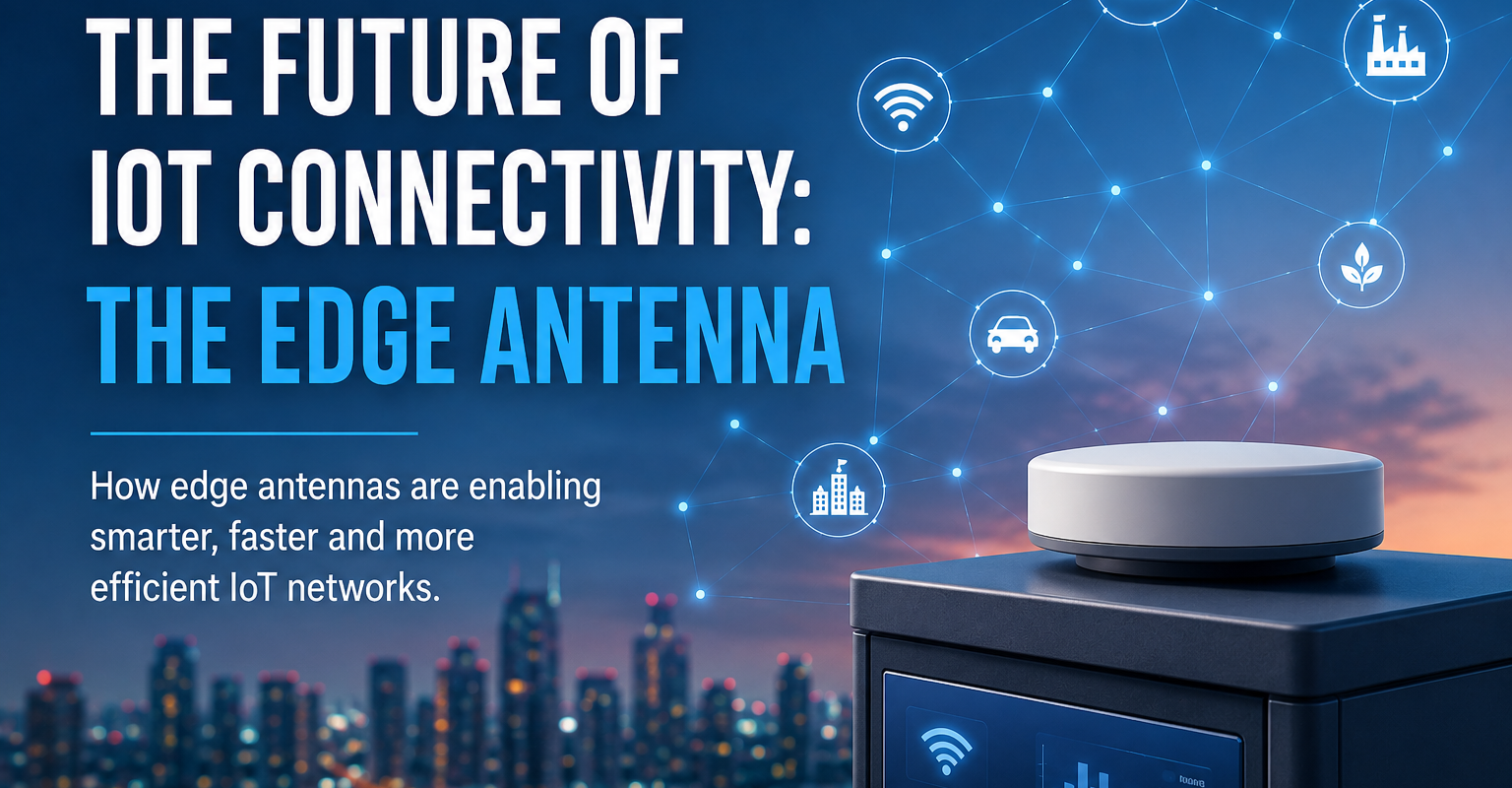
A compact, low-profile active antenna unit. Roughly the footprint of a deck of cards, fifteen millimetres thick. Inside: a 4G LTE modem module with dual MIMO antenna elements connected directly to its RF ports – no coax, no connectors, no cable loss. Also inside: a soldered MFF2 industrial eSIM with no tray and no physical access point. Out of the housing: a single USB-C cable, one metre long.
That cable carries DC power in from the SBC’s USB port. Data returns over the same cable. The SBC – whatever Pi or Rockchip or x86 board lives inside the kiosk – sees a USB network interface. Linux enumerates it as a WWAN adapter via CDC-ECM or RNDIS. No drivers to install. No kernel modules to compile. It just appears as a network interface and works.
Edge antenna architecture
eSIM platform (cloud)
|
| controls profile, network, connection
|
[ Edge antenna ]
MIMO elements – directly connected, zero cable loss
LTE modem module
MFF2 soldered eSIM – no tray, no swap, no access point
USB-C output
|
| 1 metre USB-C – power in, data out
|
[ SBC ]
Raspberry Pi / Jetson / Rockchip / any Linux board
Sees: one network interface
Knows: nothing about cellular
Does: everything else
The antenna is not passive anymore. It is not dumb. It does not sit at the end of a coaxial run waiting to be useful. It is the radio. It is where the signal is captured and converted into data. The intelligence of the connection lives at the point of signal, not at the bottom of a cable run in a box on the wall.
That is the edge antenna. Active, sealed, solid state, no moving parts, no accessible SIM, no configuration required. Mount it. Plug it in. The device is connected.
Part five
Why SGP.32 makes this possible now
The edge antenna concept has been technically possible for several years. The modem modules existed. The antenna elements existed. The form factor was achievable. What prevented it from becoming a product was one component: the SIM.
A sealed weatherproof unit with a soldered modem and no accessible SIM tray is only viable if you can manage the entire connectivity lifecycle remotely. If you need to physically open the unit to swap a SIM – to fix a provisioning error, change network operator, update an APN – you have destroyed the core proposition of the product. You have created a device that requires field service for a task that should never require human intervention.
SGP.32 removes that constraint entirely.
SGP.32 is the GSMA specification for IoT remote SIM provisioning. Not the consumer eSIM profile in a smartphone – a completely different architecture designed for industrial deployments at scale. The SIM is soldered to the PCB in MFF2 industrial form factor. Rated for the full temperature and vibration range. No slot, no tray, no physical access point, no ingress risk. And the connectivity profile – the operator credentials, the APN, the data plan, the network preference – is managed remotely via a secure channel that operates independently of the data connection itself.
Telenor IoT launched their SGP.32 commercial platform in 2025. The specification is ratified. The ecosystem is real. This is not a roadmap item. It is deployed, certified, and available today.
What SGP.32 means in practice for the edge antenna: the unit ships pre-provisioned with a bootstrap profile. It connects on arrival. The eSIM platform steers it to the strongest available network in its deployment location. If the operator changes, the profile updates remotely. If the device is lost or stolen, the connection is killed from the dashboard. A technician never needs to touch the hardware for any connectivity reason, ever.
That is the missing piece that converts the edge antenna from an engineering curiosity into a deployable product. SGP.32 is the reason the timing is now rather than three years ago.
Part six
What this does to the established market
I want to be precise about this because it is easy to overstate.
The cellular router does not disappear. For complex multi-device industrial installations, for deployments requiring sophisticated routing, VLAN management, VPN concentration, or multiple WAN inputs – the router remains the right answer. Teltonika, Robustel, Cradlepoint built strong products for strong markets. Those markets persist.
What changes is the single SBC deployment. And that is the fastest growing segment in IoT by some distance.
| Factor |
Router + passive antenna |
Edge antenna |
| Installation |
Router, separate antenna, coax run, connectors, additional PSU |
Mount unit. Plug in USB-C. Done. |
| RF performance |
Degraded by cable loss, connector loss, bends in coax |
Maximum – modem at the element, zero cable loss |
| SIM management |
Physical SIM, accessible slot, field swap required |
MFF2 soldered eSIM, SGP.32 remote provisioning |
| Developer experience |
Configure router, manage separately, two devices to monitor |
USB network interface, one device, nothing to configure |
| Failure points |
Router, antenna, coax, connectors, PSU |
One sealed unit, one cable |
| Unit cost (hardware) |
£80-200+ router plus antenna plus cable |
Sub £100 all in |
The passive antenna manufacturers face a more structural challenge. If the antenna is active – if the antenna is the radio – then a passive antenna is not the end product anymore. It is a component inside someone else’s end product. The value migrates to whoever owns the active unit. That is a different business model and a different conversation with customers.
I am not saying the passive antenna disappears either. I am saying the passive antenna as the primary cellular IoT peripheral is displaced. The category changes. The value moves.
Part seven
The software layer that completes it
Hardware solves the installation problem. It does not on its own solve the reliability problem.
Anyone who has deployed cellular connectivity on a Linux SBC knows what I mean. The connection drops. The modem loses network registration. A software reset is needed. The AT command interface needs a kick. Scripts get written. Cron jobs get added. It sort of works. Then at 2am on a Sunday it does not work and nobody knows until Monday morning when a kiosk operator calls to say their machine has been offline for eight hours.
The edge antenna ships with a software watchdog designed specifically for this deployment pattern. A silent background process – one pip install, three lines of Python to initialise – that monitors the connection, manages the reset sequence in the right order from least to most disruptive, handles PLMN reselection, interfaces with the eSIM platform for profile management, and fires a webhook when something actually needs human attention rather than just a modem kick.
The developer writes their application. The watchdog handles the cellular layer. The combination delivers the reliability that neither hardware nor software alone achieves.
Part eight
The eSIM network owns the connection
I want to zoom out to the bigger picture because I think there is something important here that goes beyond the hardware product.
What the edge antenna architecture actually describes is a clean separation of three things that the cellular router tried to bundle together.
The physical layer – the antenna, the modem, the radio. A commodity component. Interchangeable. Replaceable. The edge antenna.
The compute layer – the SBC. Application logic, data processing, local intelligence. The Pi or equivalent. Nothing to do with connectivity.
The connection layer – the eSIM platform. This is where the real control lives. The SGP.32 operator controls the profile, steers the network, manages the data, bills the consumption. Remotely. Permanently. Without touching the hardware.
The eSIM network does not just provide connectivity in this model. It owns the connection. End to end. Invisibly. The edge antenna is the physical plug between the SBC and the eSIM cloud platform. Simple, efficient, controlled at the network layer rather than the device layer.
The router tried to own all three layers simultaneously – radio, routing intelligence, and connection management in one box. That made it powerful but also complex, expensive, and difficult to manage at fleet scale. Separating the layers cleanly is simply better engineering. It is what happens when a market matures.
The router is the mainframe. The edge antenna is the PC. The eSIM network is the cloud. We have seen this pattern before. We know how it ends.
Part nine
Why now and not three years ago
Three conditions have converged in 2025 and 2026 that make this the right moment.
SGP.32 is commercial. Not a specification under development. Not a pilot programme. A launched, certified, available platform with real operator support from Telenor and others. The remote provisioning infrastructure that makes a sealed eSIM unit viable at scale exists and works today.
SBC deployments have reached critical mass. The Pi 5, the Jetson, the industrial Rockchip boards – these are not experimental platforms anymore. They are the standard compute substrate for new IoT deployments across kiosk, signage, EV charging, smart building, industrial monitoring. The market that needs the edge antenna is large and growing fast.
The cellular modem module has reached the right price point and form factor. The components needed to build the edge antenna – a Cat 4 module, MIMO elements, MFF2 eSIM capable variant – are available from Quectel and others at prices that make a sub-£100 active antenna unit commercially viable. The BOM works.
None of these three conditions were true simultaneously three years ago. All three are true today.
Part ten
Why I am publishing this rather than patenting it
I have thought carefully about this.
The hardware is not the moat. I know this because I found the core component – a 4G USB modem module with two U.FL antenna connectors – on Amazon for fifteen pounds retail. The BOM for a working prototype is under fifty pounds. Any competent engineer with a soldering iron and an Alibaba account could build the first version of this in a weekend. A patent on the form factor might slow a direct copy by six months. It would not stop it.
What has value is the category. The name. The concept clearly stated. The content infrastructure that establishes who defined this space and when. Those things compound when they are shared openly. A concept published, cited, discussed, and built upon generates more durable value than a patent nobody finds.
So here is the concept. Fully worked. Freely available. Published with my name on it and a timestamp on the page.
The companies who read this and move are the ones who build the next decade of IoT connectivity. The passive antenna manufacturers, the SBC ecosystem, the eSIM platform operators, the IoT connectivity resellers – this concept touches all of them. Some will see it as a threat to their current model. Some will see it as an opportunity to reposition. The ones who move fastest define the category on their terms.
I would rather have started that conversation than protected an idea that someone else would have articulated within a year regardless.
Conclusion
The edge antenna era
Let me describe what I think a standard IoT deployment looks like in five years.
A kiosk manufacturer specifies an edge antenna unit as a line item on the BOM alongside the SBC. It costs eighty pounds. It ships from the manufacturer pre-provisioned – the soldered MFF2 eSIM has a bootstrap profile already loaded by the eSIM platform. The installer mounts the unit on the kiosk lid or inside the top panel, plugs in the USB-C cable, and closes the enclosure. The SBC boots. Linux detects a network interface. The eSIM platform steers the connection to the best available network in that location. The device is online. The watchdog process starts in the background.
Nobody touched a SIM. Nobody ran coax. Nobody configured a router. Nobody calculated cable loss. Nobody ordered a separate antenna, a separate modem box, a separate PSU. Nobody dispatched a technician because the SIM needs swapping eighteen months later.
The eSIM operator sees the device appear in their platform dashboard – signal strength, network registration, data consumption, uptime. If the connection degrades, the platform tries a profile switch before raising an alert. The operator manages ten thousand of these devices from one screen with the same effort it used to take to manage one router over SSH.
Every component of that deployment exists today. Every piece of it is real. The edge antenna is not a concept waiting for technology to catch up. The technology caught up in 2025. The concept is the thing that was missing.
The router era served the IoT industry well for fifteen years. It was the right architecture for its time. Its time is ending.
The antenna was always the most important component in the system. It is time it started acting like it.
What comes next: I am building the category infrastructure around this concept at
edgeantenna.com – reference specifications, compatible hardware, developer resources, and a forum for the people building in this space. The Mastlink brand will produce the reference edge antenna hardware. The pingreboot software layer is in development. If you are a manufacturer, integrator, eSIM platform operator, or SBC developer who wants to talk – you know where to find me.
Nick Appleby
Twenty-five years in telecoms, cellular, M2M and IoT. Founded Westlake Communications in 2001. Founded ProRoute in 2013 – cellular routers for the UK market. Created the Fullband antenna brand.
Concept originated and first published: May 2026. This article represents original thinking on the edge antenna category documented and timestamped at this date. The concept of the active antenna unit as a USB cellular peripheral for single board computers in IoT deployments, enabled by SGP.32 remote SIM provisioning, is described here for the first time in this specific context and application.