GSM Fax: The Technology Nobody Understood, the Script I Wrote to Get It Activated, and Why the Same Problem Exists in IoT Today
By Nick Appleby4 March 202630 min read
By Nick Appleby
There is a specific kind of technical knowledge that sits in a very narrow corridor of time. Too early and nobody needs it. Too late and everybody has forgotten it existed. GSM fax lived in that corridor for about a decade, and for a few years in the late 1990s and early 2000s, I was one of a small number of people in the UK who understood it well enough to sell it, support it, and write the script that customers had to read out when they called their mobile network and asked for it to be activated.
This is the story of that technology. It is also, necessarily, the story of the longer arc that runs from a telex machine at an industrial equipment company in Whitworth in 1987 to a consignment of 180 GSM fax gateways destined for remote polling stations in Georgia during a presidential election. If that sounds like a peculiar journey through four decades of telecommunications, it was. But it makes a strange kind of sense once you see the thread that runs through all of it – which is that the distance between a technology working and a technology failing has almost always come down to one person in a support chain who understood the detail, and whether you could find them.
Whitworth, 1987: Telex, Trace Heating, and the Legal Weight of Words
I started work at Bartec in Whitworth in 1987. Bartec operated in two related but distinct product areas. The part most people associate with the name was explosion-proof electrical equipment – fittings, junction boxes, and control gear certified for use in hazardous areas where the presence of flammable gas or dust meant that a conventional electrical fitting could be the last thing anyone in the building heard. The division I worked in was ESH – electric surface heating, more commonly known as trace heating. Trace heating uses resistive heating elements run along pipes and vessels to prevent freezing, maintain process temperatures, or provide frost protection. It is unglamorous, invisible when installed correctly, and absolutely critical when a pipe carrying chemicals in a refinery decides to freeze solid at two in the morning in January.
Both sides of Bartec’s business shared something important: the customers were serious industries in serious environments. Oil and gas. Chemical processing. Offshore. Utilities. When those customers placed an order, they needed documentation that would stand up. Not just for commercial reasons, but for regulatory and safety reasons. In industries where something going wrong could kill people, the paper trail matters enormously.
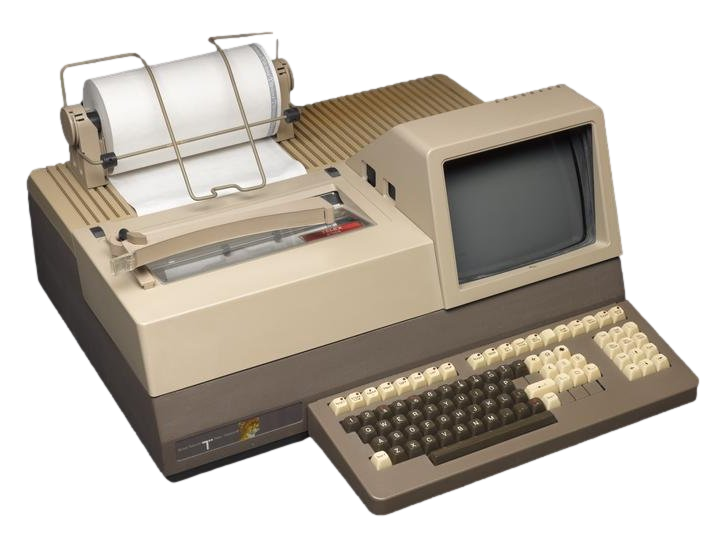
And when you needed to place a formal purchase order with a supplier in Germany or the United States, you did not pick up the phone. You did not send a letter. You used the telex machine.
The telex network was, by 1987, already middle-aged. Developed in the 1930s, it had been the backbone of international business communication for half a century. You typed your message on a keyboard that looked like an industrial typewriter, and the text was transmitted over the public switched telex network as encoded electrical pulses. At the other end, a printer produced a paper record. Both sender and receiver had a logged, time-stamped copy. The network authenticated the connection through the telex answerback code – a unique identifier for each terminal, transmitted automatically at the start of every session, confirming that the correct machine at the correct registered address had received the message.
That authentication was what gave telex its legal weight. When Bartec sent a purchase order to a supplier in Stuttgart, both parties had an authenticated record that a specific terminal at a specific registered address had sent a specific message at a specific time. Courts recognised this. Contracts formed by telex were binding. You could enforce them.
The fax machine was already beginning to appear in offices in 1987. But nobody was treating fax documents as legal instruments – and for good reason. A fax was a photocopy of a document transmitted over a phone line. A photocopy has never carried the evidential weight of an original. There was no authentication mechanism. Anyone with a fax machine could send a document purporting to come from anywhere. The receiving machine printed on thermal paper that faded within a few years. The telex answerback – that elegantly simple authentication mechanism – had no equivalent in the fax world. The original signed document still had to follow by post for anything that actually mattered.
This created a practical absurdity that anyone who worked in business during the late 1980s will remember. You would fax a contract so that the other party had something immediately, and then physically post the signed originals. The fax was a preview. The post was the reality. The telex, by contrast, was the thing itself.
When Fax Finally Became Legal – and Why It Took So Long
The fax machine’s transition from unofficial convenience to legally recognised instrument happened gradually, unevenly, and without a single defining moment. It was driven partly by judicial pragmatism – courts recognising that refusing to acknowledge fax documents was increasingly disconnected from commercial reality – and partly by regulatory change.
In the United Kingdom, the shift came through case law across the 1990s. The general principle that emerged was that a faxed signature could satisfy a requirement for writing, provided both parties had agreed to conduct the transaction by fax, and provided there was no specific statutory requirement for an original wet-ink signature. Companies Act obligations, financial services regulations, and conveyancing law all had their own rules. For most general commercial contracts and purchase orders, fax became de facto acceptable during the mid-1990s – which is when you started seeing fax numbers on business cards as prominently as telephone numbers, and when fax machines moved from the executive suite to every department.
But here is the thing that strikes me now, looking back: the telex had solved the authentication problem before it was even recognised as a problem. The answerback code was, in essence, a cryptographic identity for each terminal – not mathematically sophisticated, but legally sufficient because the network itself vouched for it. Nobody designed telex to be legally robust. It just was, because the network architecture made impersonation impractical.
Fax had no such architecture. And email, when it arrived in business in the early 1990s, made the problem orders of magnitude worse, because now documents could be created, modified, and transmitted with no physical artefact involved at all. The same questions that had dogged fax – is this authentic? is this binding? – arrived again at much greater volume and speed.
The Electronic Communications Act 2000 in the UK and the E-SIGN Act in the US were the legislative responses. They created frameworks for electronic signatures and electronic contracts that finally settled most of the outstanding questions. By the time those Acts passed, fax had already been accepted for most commercial purposes, but the legal architecture they established – underpinning everything from DocuSign to encrypted email – was built in response to the challenge that electronic documents as a whole posed to the traditional concept of a signed original.
The telex network outlasted all of this. Telex International closed the UK public switched telex network in 2007. By then the machine at Bartec had been gathering dust for a decade, and the industries that had relied on it most had moved on. But the problem telex had solved – how do you make a remotely transmitted document legally reliable? – turned out to be one that took everyone else another twenty years to properly address.
From the Shop Floor to the Network: A Route Through Sales and BT
After Bartec I moved into sales, working across a few different companies through the early and mid-1990s. Sales suited me. It had the same underlying logic as technical support – understanding what the customer actually needed, not just what they said they wanted – but it added the discipline of making a commercial case for it. By the time I joined BT in 1998 I had enough background in both industrial environments and communications to understand why businesses were increasingly dependent on reliable connectivity, and what happened when they did not have it.
BT in 1998 was at an interesting moment. The Y2K problem – the millennium bug – was consuming enormous amounts of resource across the entire technology sector, and BT was no exception. The concern was real and the preparation was serious: embedded systems across the telecommunications network had to be audited, tested, and in some cases replaced or patched to ensure they would handle the date transition from 31 December 1999 to 1 January 2000 without failing. Working through that period gave me a granular view of how deeply telecommunications infrastructure was embedded in everything else – not just in phone calls, but in the systems that businesses depended on to function at all.
I was working in BT’s channel sales operation, which meant working with and through resellers and partners rather than directly with end customers. Channel sales is where you learn the ecosystem – who the good resellers are, what makes a product work for a partner’s customer base, how the gap between a manufacturer’s product specification and a customer’s actual requirement gets bridged (or does not). It also gave me a thorough understanding of how BT’s own product portfolio was structured, what the network could do, and crucially, what it took to get things provisioned correctly when the customer’s requirement went beyond standard.
In 2001 I set up Westlake Connect. The timing was deliberate. The 3G licensing auctions had happened in 2000, broadband was beginning its slow roll-out across the UK, and mobile data was moving from a novelty to something businesses were starting to take seriously. The channel sales background meant I understood how to build a reseller business. The technical background meant I could support products properly. And the BT years had shown me exactly where the gaps were between what customers needed and what the mainstream telecoms market was offering them.
The convenience of cellular was obvious. What was less obvious, but increasingly apparent to businesses with more complex communication needs, was what happened at the edges of the fixed telephone network. There were locations in the UK – rural farms, remote industrial sites, construction locations, temporary offices – where the economics of PSTN installation were prohibitive or where the lead times were measured in months. Planning a site around the availability of a BT line was a constraint that the fixed telephone network had imposed on businesses for decades. GSM changed the equation. If you had a mobile signal, you had a telephone.
But businesses did not just need telephones. They needed fax. Fax was, by the late 1990s, not just a convenience but a business requirement – orders, contracts, technical drawings, compliance documentation. A site that had mobile coverage but no fax capability was still significantly hampered. And the landline cost issue ran deeper than just installation. Call charges to mobile numbers from fixed lines were, in the late 1990s, dramatically higher than calls between fixed lines. A business making significant volumes of calls to mobile phones was paying a premium that felt unjust, because it was – the margin was entirely regulatory and commercial rather than reflective of any actual cost difference.
This created the conditions for a class of product that came predominantly from Scandinavia: the premicell, or fixed cellular terminal.
Premicells: Why Scandinavia Understood This First
The Nordic countries had been early adopters of cellular telephony, partly because their geography made fixed-line infrastructure expensive and sparse. In northern Sweden and Norway, small towns and remote communities had been relying on mobile networks for reliable communication in ways that had no equivalent in densely wired countries like the UK. The industries operating there – forestry, mining, oil and gas on the Norwegian continental shelf – needed communication infrastructure that could function in locations where telephone lines were a luxury rather than a given.
From this environment came a generation of manufacturers who built fixed cellular terminals: desktop devices that connected to a GSM network via a SIM card and presented a standard analogue telephone interface to whatever you connected to them. Plug in a telephone, and you had a mobile-network voice call. Plug in a fax machine, and – in theory, and with the right SIM provisioning – you had GSM fax.
The commercial rationale in the UK was twofold. First, businesses in locations without PSTN could now have a desk telephone and a fax machine without waiting for BT to lay a line. Second, businesses that made large volumes of calls to mobile numbers could route those calls through an on-site fixed cellular terminal and pay mobile-to-mobile rates rather than fixed-to-mobile rates, which were considerably cheaper under the tariff structures of the time. The premicell was simultaneously a connectivity solution and a cost reduction measure.
Through Westlake Connect, I became one of the UK’s leading resellers of these products. The range was broad – units from Wavecom, from Falcom, from various Scandinavian manufacturers – and the customer base covered everything from rural businesses to logistics companies managing high volumes of calls to drivers’ mobile phones.
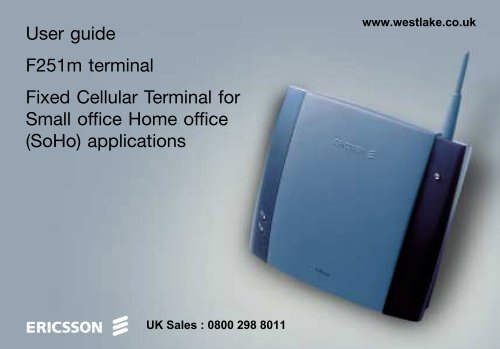
The Ericsson F251m was one of the more capable products in this space. Ericsson had designed it specifically as a multi-service fixed cellular terminal: voice, data, and critically, Group 3 analogue fax. The F251m had an RJ11 port for connecting a standard telephone or fax machine, and its “m” designation was specifically what distinguished it from the single-service variants – the “m” indicating the multi-service capability that included fax alongside voice and V.90/V.34 data.
Fax on the F251m worked correctly, but it required knowing a detail that was not prominently documented. In many network configurations, before sending a fax you needed to enter the code #88# on a connected DTMF telephone to signal to the terminal that it should enter fax mode. Get that right, use a correctly provisioned SIM, and the F251m was genuinely reliable. Miss either of those details and you were troubleshooting for hours. That kind of detail – a four-character code that changed everything – was typical of the terrain.
The GSM Fax Technical Problem: Why It Needed Its Own Bearer
To understand why getting GSM fax working required special provisioning – and why a standard voice SIM simply could not do it – you need to understand what GSM actually is at a network level, and how it treats different types of communication.
GSM is a digital cellular standard. When it replaced the analogue TACS network in the early 1990s, voice calls became not continuous analogue signals but digitally encoded streams. A GSM voice call uses a codec – initially the Full Rate codec at 13 kilobits per second – that compresses speech for transmission across the air interface and the network core, then decompresses it at the other end.
This works beautifully for human voice. It is catastrophic for fax.
A Group 3 fax machine communicates using the T.30 protocol: a carefully choreographed handshake of analogue tones over which two machines negotiate capabilities, exchange control signals, and transmit image data. Those tones are exquisitely timing-sensitive. The GSM voice codec is designed to compress speech by discarding audio information the human ear does not need – processing latency and timing distortion are tolerable in voice conversation because the human auditory system is forgiving. The T.30 protocol is not forgiving. Compress, stretch, and phase-shift the fax tones slightly, and the handshake fails. The fax machines report a communication error and hang up.
The GSM standards bodies knew this from the beginning. Their solution was a separate bearer service. When a GSM device sets up a call, it includes a Bearer Capability field in the setup message. For a voice call, this field specifies a speech bearer. For a fax call, it specifies a fax bearer – which tells the network to route the call over a circuit-switched data channel that bypasses the voice codec entirely, preserving the timing integrity of the T.30 protocol. The call travels without the destructive compression that would otherwise break it.
But this created a provisioning requirement. The network’s Home Location Register – the HLR, the database that holds every subscriber’s profile – stores a list of which bearer services each SIM is authorised to use. A standard voice SIM has only speech bearer service enabled. If a device attempts to make or receive a fax call on a voice-only SIM, the MSC – the Mobile Switching Centre – checks the HLR, finds that fax bearer is not authorised, and rejects the call.
For incoming faxes, the situation was slightly more complex. Fax calls needed their own MSISDN – their own number – because the network needed to know before answering how to handle the incoming bearer. A fax MSISDN provisioned in the HLR told the network to expect and route fax bearer calls to that subscriber. Voice and fax could coexist on the same SIM, each with its own number, but both had to be explicitly configured.
This was not a bug. It was deliberate architecture – the network legitimately treated voice, data, and fax as distinct services with different billing profiles. Enabling fax bearer was a provisioning change and a billing configuration change simultaneously. It required someone on the operator’s side who understood the HLR, knew which screen to navigate to, and had the access level to make the change.
Those people existed. They were just not the people who answered the phone when a customer called to ask why their fax machine was not working.
The Nokia Communicator, the O2 XDA, and the Gap Between Device and Network
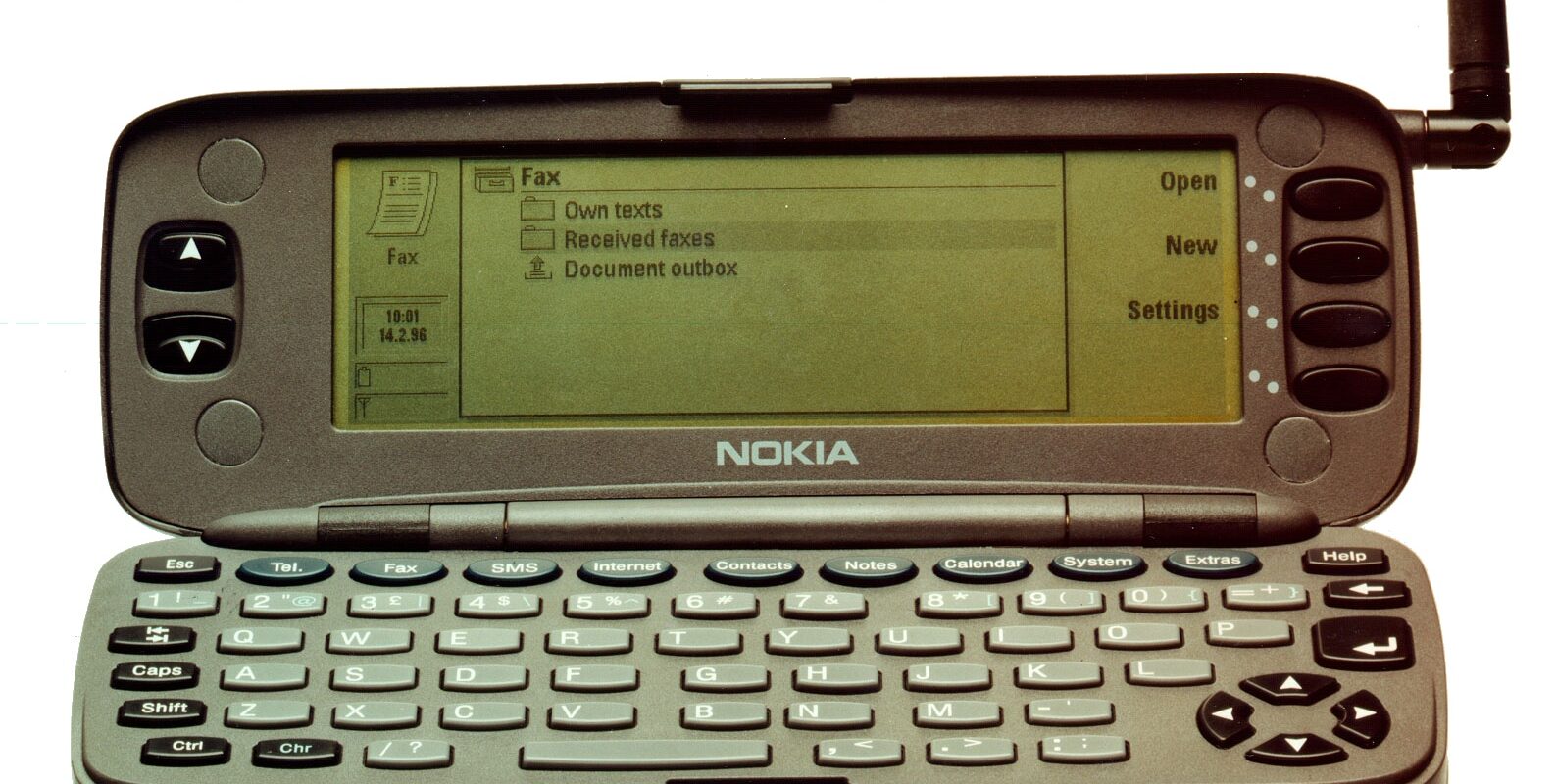
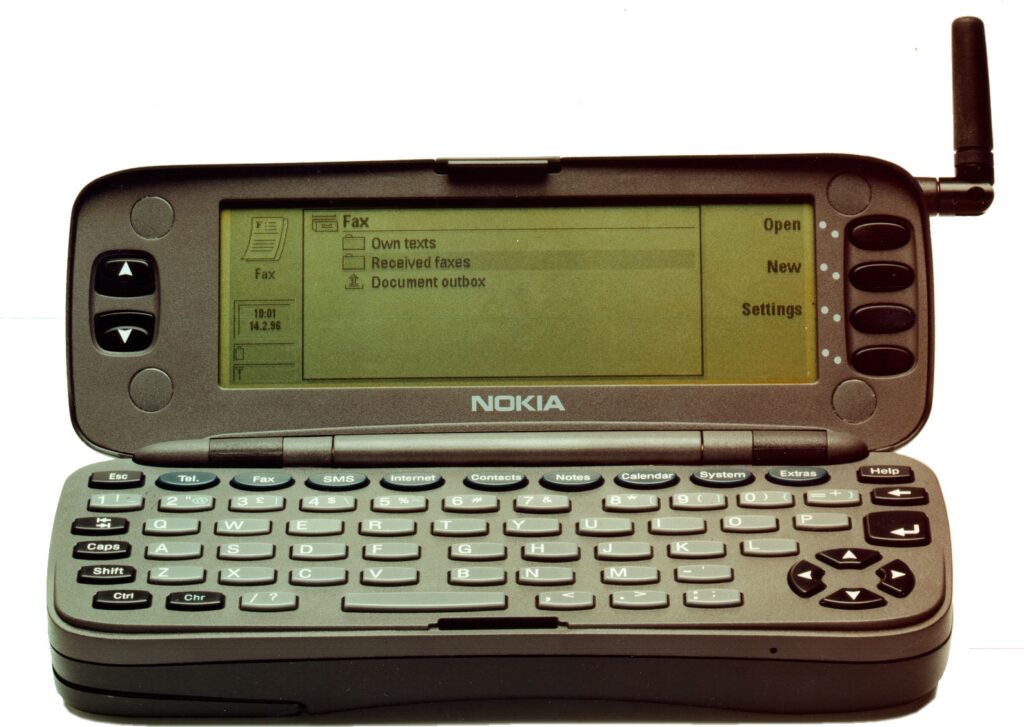
I had a Nokia Communicator. If you worked in telecoms in the late 1990s you will know exactly what I mean. If you did not, the Nokia 9110 – which I had around 1998, with the 9210 following a few years later – was a clamshell device that opened to reveal a full QWERTY keyboard and a screen capable of formatted text, web browsing, email, and fax. It was, in every meaningful sense, a smartphone before the word existed. Heavy enough to be mistaken for a small book, large enough to fill any normal trouser pocket, and capable enough to embarrass most devices that followed it.
The Communicator could receive faxes. Not as a novelty – as a fully functional feature, using GSM fax bearer service, rendering the received document on screen. When I wanted to receive a fax on my Communicator, it arrived on my fax MSISDN, was delivered over a circuit-switched data channel, and the device displayed it. I could send fax documents the same way.
To do any of this, I had needed to call my network operator and ask them to enable GSM fax and provision a fax number.
That call had been an education. The first person I spoke to did not know what I was asking for. The second thought I wanted a separate data SIM. The third had never encountered the concept of fax bearer service. Eventually I reached someone who understood immediately – older, clearly from the network deployment side of the business rather than customer services – who pulled up the right provisioning screen and had it done in a few minutes. He knew what a Nokia Communicator was. That was the tell. The device was niche enough that only someone who had been around the GSM network from the beginning, and understood its full service portfolio, would recognise it.
Later came the O2 XDA – the first mass-market Windows Mobile device in the UK, launched in 2002, and genuinely transformative in how it integrated mobile data with a handheld device. I had that too. And a succession of other devices through the early 2000s – though never a Blackberry, which always felt like a product for people whose companies had made the decision for them rather than those who had come to their devices through genuine curiosity about what the hardware could do.
The common thread through all of these devices was that their capabilities consistently outpaced the ability of mobile networks’ customer-facing teams to support them. The technology existed. The network could do it. The device could do it. But somewhere between the customer’s question and the network’s HLR, there was a gap that required finding the right person.
The Script
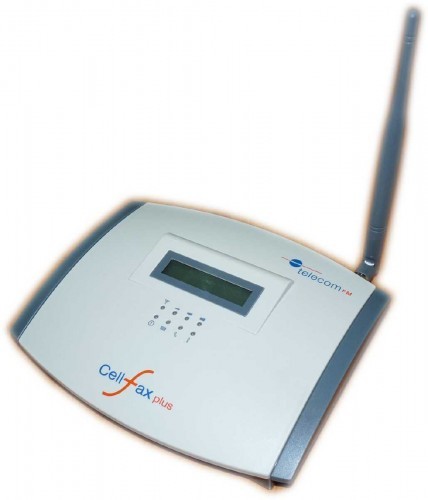
When I started distributing GSM fax products – the Ericsson F251m, then later the Telecom FM CellFax – customers were buying fixed cellular terminals specifically for fax capability. That meant they needed correctly provisioned SIMs. And that meant they needed to successfully navigate a call to their mobile operator and emerge the other end with fax bearer service enabled and a fax MSISDN configured.
Many of them could not do it without help.
I wrote a script. Not a canned-phrase customer service script, but a technical briefing document that walked customers through exactly what to ask for, in the right terminology, in the right sequence. It specified that they should ask for fax bearer service to be enabled and a fax number provisioned on their SIM. It gave them the technical language so that the person on the other end of the phone had a chance of recognising what was being asked. And it included a piece of practical advice that turned out to be consistently useful: if the first person you speak to does not understand the request, ask to be transferred to technical support rather than customer services, and look for someone who has been with the company since before 2000. Ask if they know what a Nokia Communicator is. If they do, you have found the right person.
It worked. The knowledge existed in those networks. It was held by a specific generation of engineers who had provisioned GSM from the beginning, who understood that fax and data were distinct bearer services, who had navigated this territory before retail support teams were even involved. The script’s job was to help customers find those people rather than cycling endlessly through frontline agents who had been trained on voice tariffs and contract upgrades.
From Premicells to CellFax to 3G: An Evolution
The CellFax was a Telecom FM product – a purpose-built GSM fax gateway, not a general-purpose terminal but a device engineered specifically around the requirements of reliable Group 3 fax over GSM. I came to distribute Telecom FM’s products as a consequence of having already become one of the UK’s leading resellers of GSM gateways and premicells. The product range was a natural extension of what Westlake was already doing, and Telecom FM’s focus on getting the interworking right between T.30 fax signalling and the GSM data bearer showed in its field reliability.
But by the time I was distributing CellFax, the market was already beginning to evolve beyond it. 3G was coming, and with it the possibility of packet-switched data at speeds that made circuit-switched data services look antique. The Option GlobeSurfer was one of the first products that showed where things were going – a 3G router that brought broadband-class connectivity to locations that had never had it, using exactly the same logic that the premicell had applied to voice and fax. If you have a cellular signal, you have connectivity.
The Telecom FM DataRouter followed, and a range of other 3G routers from manufacturers who understood that the market for cellular data connectivity was going to be enormous. And in that wave came the first Teltonika router we sold – the RUT100. Westlake became one of the first UK resellers with a direct relationship with Teltonika. That relationship turned out to matter more than we knew at the time. The RUT100 was the beginning of something, though none of us quite knew it yet.
Georgia, the FCO, and 180 CellFax Units
In the early 2000s we sold 180 CellFax units for deployment at remote polling stations across Georgia – the country in the South Caucasus, not the US state – for a presidential election. The application was exactly what it sounds like: remote polling locations needed to transmit official results and election paperwork to central election administration, reliably, in locations where fixed-line telephone infrastructure was either absent or could not be trusted.
I was introduced to this project by the Foreign and Commonwealth Office who I had sold several cellular fax devices for their own use. A consignment of 180 fax gateways going to Georgian polling stations during an election of international significance was exactly the kind of logistical and technical support that would have had FCO involvement – whether in coordinating the supply chain, in working with international monitoring organisations, or in ensuring that the communication infrastructure for result transmission was in place. I worked with the FCO on this, and the framing made sense: this was not a commercial sale in the ordinary sense but a contribution to infrastructure that mattered for democratic integrity.
The fax, for all its antiquated image, was exactly the right technology for this specific application. It produced a paper document that election officials understood and could handle. It used a protocol that was legally recognised in most jurisdictions. It required no technical sophistication from polling station staff beyond connecting a fax machine they already knew how to operate. And it worked over GSM coverage in locations where no fixed line would ever run.
Fax documents were, by the early 2000s, legally accepted in most commercial and administrative contexts. The Georgian election authorities, the international monitors, and the central administration all knew what a faxed document was and what it meant. The chain from telex – legally unimpeachable from the start – through the slow acceptance of fax to this moment was, in a small way, complete. A form of remote document transmission that had begun its legal journey in the back offices of companies like Bartec in Whitworth had arrived at a presidential election in the Caucasus.
The Pattern That Never Changes
Looking back across this history – telex, fax, GSM fax, premicells, 3G routers, and what came after – the thing that strikes me most is not the technology itself. The technology changed constantly. What did not change was the gap between what a technology could do and what the people responsible for supporting it actually knew.
Every step of the way there was a version of the same problem. The telex engineers who built the network knew how authentication worked. The GSM engineers who designed the bearer service architecture knew exactly why fax needed separate provisioning. The Ericsson engineers who built the F251m knew about the #88# code. The network provisioning teams who had deployed GSM from the beginning knew how to enable fax bearer in the HLR. But that knowledge did not reliably reach the frontline. By the time a customer called to ask why their fax machine was not working on GSM, the person who answered the phone had been trained on voice tariffs and had never seen a Nokia Communicator.
The script I wrote for GSM fax customers was not sophisticated. It was a piece of paper that said: here is what to ask for, here is the terminology, here is how to find the person in the network who actually knows. But it saved customers hours of frustration, and in some cases it was the difference between a working installation and a returned product.
That same dynamic – specific technical knowledge that exists somewhere in a support organisation but is not accessible through normal channels – is still present in IoT connectivity today. The details have changed. Instead of HLR provisioning for fax bearer service, we are talking about APN configuration, private IP addressing, SIM whitelisting, firewall rules on operator platforms, and the specific behaviour of multi-network roaming SIMs in contested coverage environments. Instead of a fax MSISDN, we are dealing with static IP assignment and VPN gateway configuration.
But the shape of the problem is identical. A customer buys a cellular IoT device. They insert a SIM. The device does not behave as expected. They call their SIM provider’s support line. The person who answers has been trained on consumer SIM products and has no frame of reference for an industrial IoT application running on a private APN with specific routing requirements. Somewhere in the operator’s organisation, there is an engineer who knows exactly what the issue is and could resolve it in ten minutes. The challenge is finding them.
Small knowledge saves hours. That was true with a telex answerback code in 1987. It was true with a GSM fax bearer service in 1999. It was true with an Ericsson F251m and the #88# code in 2001. And it is true today with every cellular IoT deployment that sits between a customer who needs it to work and a support organisation that was not built to understand why it is not working.
The technology changes. The gap does not.
Nick Appleby has worked in telecoms, M2M, and IoT for over 25 years. He founded Westlake Connect, one of the UK’s early specialist distributors of GSM gateways and fixed cellular terminals, and was among the first UK resellers with a direct relationship with Teltonika. He now works across a range of IoT connectivity, antenna, and IoT SIM connectivity solutions.
25+ years in telecoms and IoT. Former founder of ProRoute, Fullband, and Westlake Connect. Currently building IoT connectivity resources and writing about how the industry actually works. On the hunt for truth and common sense.
About This Site
Nick Appleby writes here in a personal capacity. Views, recommendations, and technical guidance are his own and do not represent any employer, partner, or associated organisation.
Content is informational only and does not constitute professional advice. No liability is accepted for actions taken in reliance on it. Always consult your supplier before procuring or deploying products or services.