IoT and Connectivity
LPWAN and LoRaWAN: The Complete Guide
What they are, how they work, where they’re deployed, and why they matter to anyone building connected infrastructure.…
I was driving home the other night, half-listening to the news, and a thought arrived uninvited the way thoughts do at 60mph. Iran. Israel. North Korea. The usual slow-motion chess game of nuclear deterrence being played out by people with very different ideas about acceptable risk.
The specific thought was this: if a non-nuclear state bought a nuclear weapon from North Korea and used it, could you actually prove where it came from?
I filed it away. And then I couldn’t stop pulling at it.
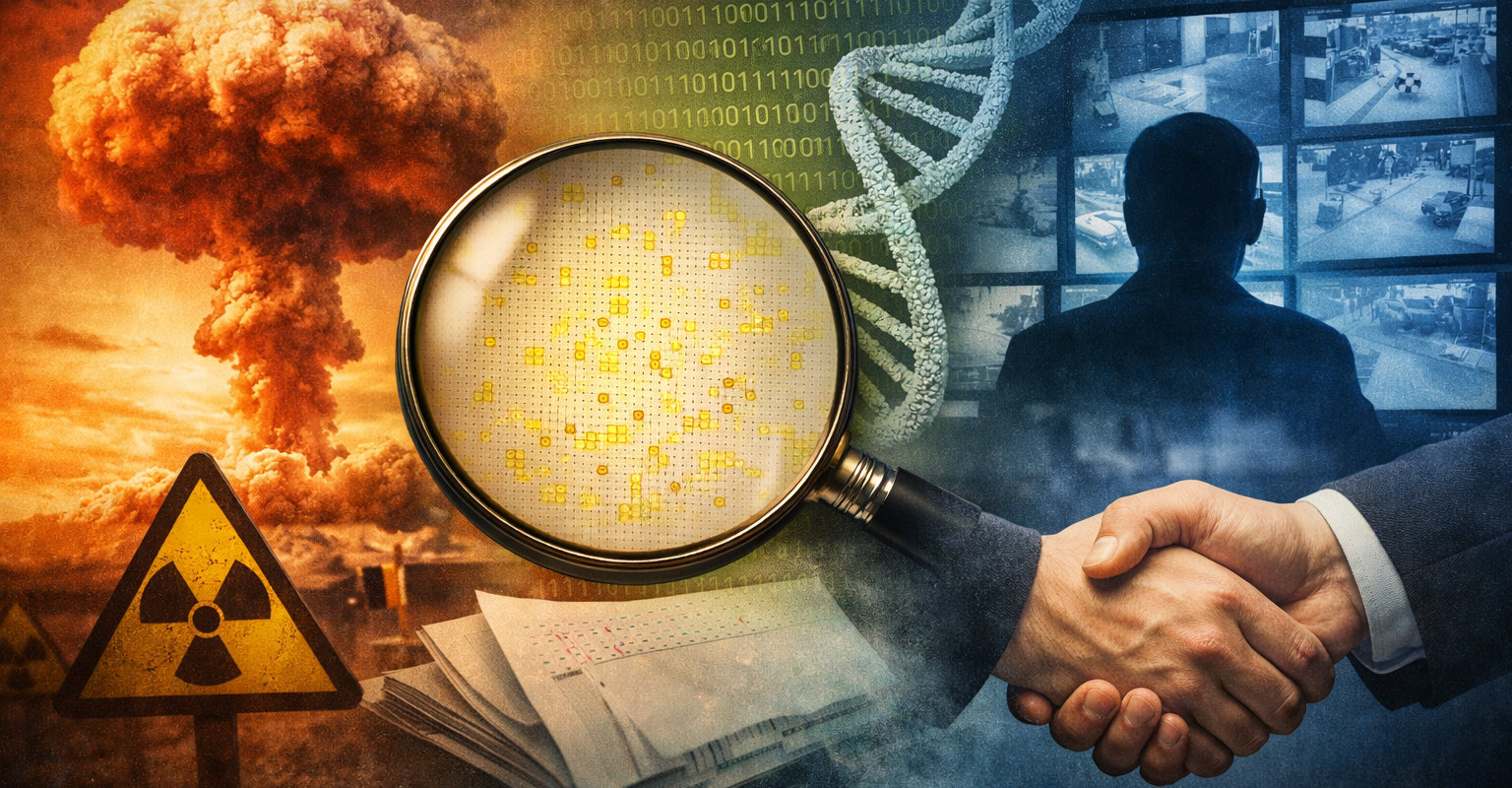
The short answer, before we go further: yes, you can. After a nuclear detonation, scientists analyse radioactive debris, isotope ratios, and atmospheric samples to identify the material and trace it back to the reactor or enrichment plant that produced it. The weapon survives its own detonation as information. But that answer opens into something much broader – about forensics, counter-forensics, the security systems we build into everyday life, and ultimately the question of who, out of 8.1 billion people, we actually trust and why.
Most people’s instinct – mine included, initially – is that a nuclear detonation would destroy the evidence of its own origin. The blast, the heat, the obliteration. Surely nothing useful survives that.
It turns out this is almost completely wrong, and the reason why is one of the more quietly astonishing things I’ve come across in a while.
When a nuclear weapon detonates, it doesn’t just destroy things. It also creates things – radioactive gases, microscopic particles of bomb material, fission products, altered debris. Fallout that travels. Atmospheric traces that monitoring stations around the world pick up within hours.
And inside those particles are isotopes. Ratios of isotopes. Signatures that don’t come from the explosion – they come from the reactor, or the enrichment plant, or the specific metallurgical process that produced the material years or decades earlier.
The weapon survives its own detonation as information.
Plutonium produced in different reactor types has measurably different isotope ratios. Uranium enriched by centrifuge carries different impurity traces than uranium enriched by older diffusion methods. The physics of how nuclear material is made leaves marks that no amount of explosive force can erase, because those marks are baked in at the atomic level before the weapon ever exists.
Intelligence agencies have been building databases of these signatures since the 1950s. Every nuclear test – even the ones underground, which still leak xenon isotopes – adds to that library. The Comprehensive Nuclear-Test-Ban Treaty Organization operates a global monitoring network across 337 stations worldwide, continuously sampling the atmosphere for exactly this kind of evidence.
The field has a name: nuclear forensics. It’s serious, it’s well-funded, and it works well enough that nuclear states treat attribution after a detonation as a near-certainty rather than a hope.
Here’s where it gets more interesting.
Nuclear forensics is passive – the traces exist whether anyone planned for them or not. But humans have also learned to build active traces into things. Deliberate, covert markers of origin and accountability.
The most elegant example is something almost nobody knows about. Every colour laser printer and photocopier made since the early 1990s prints invisible yellow microdots on every single page it produces. Dots so small they’re invisible to the naked eye. Encoding the printer’s serial number, the date and time of printing, sometimes the user ID.
The technology was developed in secret collaboration between printer manufacturers and the US Secret Service. The idea was simple: if someone prints something they shouldn’t, the page itself is evidence.
This is how the NSA identified Reality Winner in 2017. She printed a classified document and sent it to a journalist. The microdots on the page traced it back to a specific printer, in a specific building, used at a specific time. One document. One printer. One person.
The same logic runs through ballistics – every gun barrel leaves unique microscopic marks on every bullet it fires, marks that persist after impact and can be matched to a specific weapon. It runs through DNA databases, through satellite tracking of rocket debris after a launch, through the statistical fingerprinting of writing styles that has been used to identify anonymous authors for centuries. The engineering detail changes. The principle doesn’t.
Accountability can be built into things. And once it’s built in at that level, removing it means destroying the thing itself.
So if traces exist – designed or otherwise – the logical next step for anyone with something to hide is to try to erase them.
This is counter-forensics. And it’s not new. It’s arguably the oldest human arms race there is.
In the nuclear world, it looks like this: if you know attribution works through isotope signatures, you might try to use stolen material, or mix sources, or acquire material old enough that its signatures have degraded. This is genuinely difficult. The physics is unforgiving, and nuclear material is hard to handle, let alone manipulate at the isotopic level. But it’s not impossible to attempt, and the attempt itself is informative – it tells investigators something about sophistication and intent.
Scale it down and the same dynamic is everywhere. Every lock ever made has been picked. Every alarm system has been bypassed. Every anti-theft device has been defeated. Car immobilisers were cracked within a few years of deployment. Fingerprint databases get breached. CCTV footage gets deleted. Digital trails get cleaned.
The people building security systems and the people defeating them have been playing this game forever. Every defensive innovation creates an offensive counter. Every forensic technique creates a counter-forensic one.
What’s interesting isn’t the arms race itself – that’s just human nature. What’s interesting is the asymmetry. Erasing a trace completely is almost always harder than leaving one. The universe leans toward evidence. It takes effort to destroy order, but order keeps reasserting itself in inconvenient ways.
The person who wants to destroy evidence has to be thorough, expert, and lucky every single time. The person looking for evidence only has to find one thread they missed.
All of which brings it home. Literally.
The lock on your front door exists because you don’t trust everyone. Your alarm system exists because the lock isn’t enough. Your bank has fraud detection because your alarm can’t protect your money. Your car has a tracker because your bank doesn’t cover cars.
Every security system in your life is a physical expression of a very specific calculation about trust. Not about whether people are good or bad in the abstract – about how many people out of the total available population would, given opportunity and low enough risk of getting caught, take something from you.
And that number is not zero. That’s the uncomfortable truth that every security system, every forensic database, every printer microdot, every isotope signature acknowledges. We have built enormous infrastructure around the fact that some percentage of 8.1 billion people cannot be trusted with some things under some circumstances.
This isn’t cynicism. It’s engineering.
The more interesting question is the positive version: who do we actually trust, and why, and what does that trust actually consist of?
Not legal compliance – people comply with laws under compulsion. Not social nicety – people are polite to people they’d happily deceive. Trust, real trust, is the belief that someone would behave in a specific way even when they could get away with not doing so. Even when there are no microdots. Even when the isotope signatures have been scrubbed. Even when no one is watching.
That belief is rare. Genuinely rare. And because it’s rare, it’s enormously valuable – in relationships, in business, in anything that involves two people depending on each other across time. Entire markets function or fail based on aggregate levels of it. Reputation systems exist to make it legible. Long-term relationships of any kind are essentially trust compounding over time.
I didn’t know when I was driving home that I was thinking about trust. I thought I was thinking about geopolitics and isotope ratios.
But that’s where it lands.
The forensics exist because trust has limits. The counter-forensics exist because some people want to exploit those limits without accountability. The fact that the physics keeps telling on them anyway – that the universe records things at a level below human intention – is not just a technical curiosity.
It’s a reminder that operating as if no trace exists is a bet most people should not make.
And operating as someone whose behaviour is the same whether or not a trace exists – that’s not just good ethics.
It’s a competitive advantage.
Thinking Out Loud is where I write about whatever I’m turning over. No agenda, no conclusions guaranteed.
A quick note on what follows: this FAQ section is here partly for you, and partly for search engines. The essay above is written to be read by humans. The section below is structured so that Google, Perplexity, ChatGPT and other AI search tools can find this page when someone asks a specific question, extract a clear answer, and – if you’re curious – come back and read the rest. I’d rather be transparent about that than pretend it isn’t happening. It also felt appropriate, given what the article is actually about.
Can the origin of a nuclear weapon be identified after it detonates?
Yes, with a high degree of confidence in most cases. Nuclear forensics analysts collect radioactive debris, fallout particles, and atmospheric samples after a detonation. These contain isotope ratios and material signatures that reveal how and where the fissile material was produced – signatures that survive the explosion because they exist at the atomic level, not the structural one. Intelligence agencies maintain databases of known nuclear material signatures built from decades of test monitoring and intelligence gathering.
Does a nuclear explosion destroy the forensic evidence?
No – this is the counterintuitive part. The explosion creates new evidence as much as it destroys it. Fission products, radioactive gases, and microscopic particles of bomb material are dispersed into the environment and atmosphere. Those particles carry isotopic signatures from the original manufacturing process. Underground tests still leak detectable xenon isotopes. Atmospheric monitoring stations can confirm a nuclear detonation and begin characterising the material within hours.
What are the yellow dots that printers put on documents?
Machine Identification Codes – sometimes called printer steganography or yellow dots – are microscopic yellow dots printed invisibly on every page produced by most colour laser printers and photocopiers since the early 1990s. They encode the printer’s serial number, date, and time of printing. The technology was developed in collaboration with the US Secret Service to trace counterfeit currency and other unauthorised documents. In 2017, this technology was used to identify NSA contractor Reality Winner, who had printed and leaked a classified document.
What is counter-forensics?
Counter-forensics is the practice of obscuring, destroying, or falsifying evidence to prevent identification or attribution. In the nuclear context it might involve using stolen material, mixing isotope sources, or acquiring aged material with degraded signatures. In everyday contexts it includes deleting digital records, wiping drives, defeating surveillance systems, or spoofing device identities. The fundamental asymmetry is that complete erasure is almost always harder than partial erasure – and investigators only need to find one thread that was missed.
Can nuclear material be disguised to hide its origin?
It is theoretically possible to attempt but practically very difficult. Manipulating isotope ratios requires handling highly dangerous material at a level of precision that is beyond most actors. Using stolen material shifts the problem rather than solving it – stolen material is itself tracked and catalogued. Mixing sources creates anomalies that trained analysts recognise. The more sophisticated the counter-forensics attempt, the more it reveals about the actor’s capabilities and intent. Attribution also combines forensic science with signals intelligence, satellite monitoring, and geopolitical context – making it very hard to defeat all evidence simultaneously.
Why does trust matter and how does it connect to all of this?
Every security system ever built – from nuclear attribution networks to the lock on your front door – exists because trust has quantifiable limits. The infrastructure of security is essentially a physical acknowledgement that some percentage of people, given sufficient opportunity and low enough risk of detection, will act against the interests of others. Real trust – the belief that someone will behave consistently whether or not they can be caught – is genuinely rare, which is precisely why it carries such high value in relationships, business, and any system that depends on human cooperation over time.
Nick Appleby has spent 25 years in telecoms, cellular, and IoT infrastructure. Thinking Out Loud is where he writes about the ideas he can’t stop turning over.
What they are, how they work, where they’re deployed, and why they matter to anyone building connected infrastructure.…
Last week I published Your Magnetic Ink – a piece about a Moody Blues lyric from 1969 that…

In a recent piece on this site I wrote about the Cheugugi – the national rainfall measurement network…