What they are, how they work, where they’re deployed, and why they matter to anyone building connected infrastructure.
What Is LPWAN?
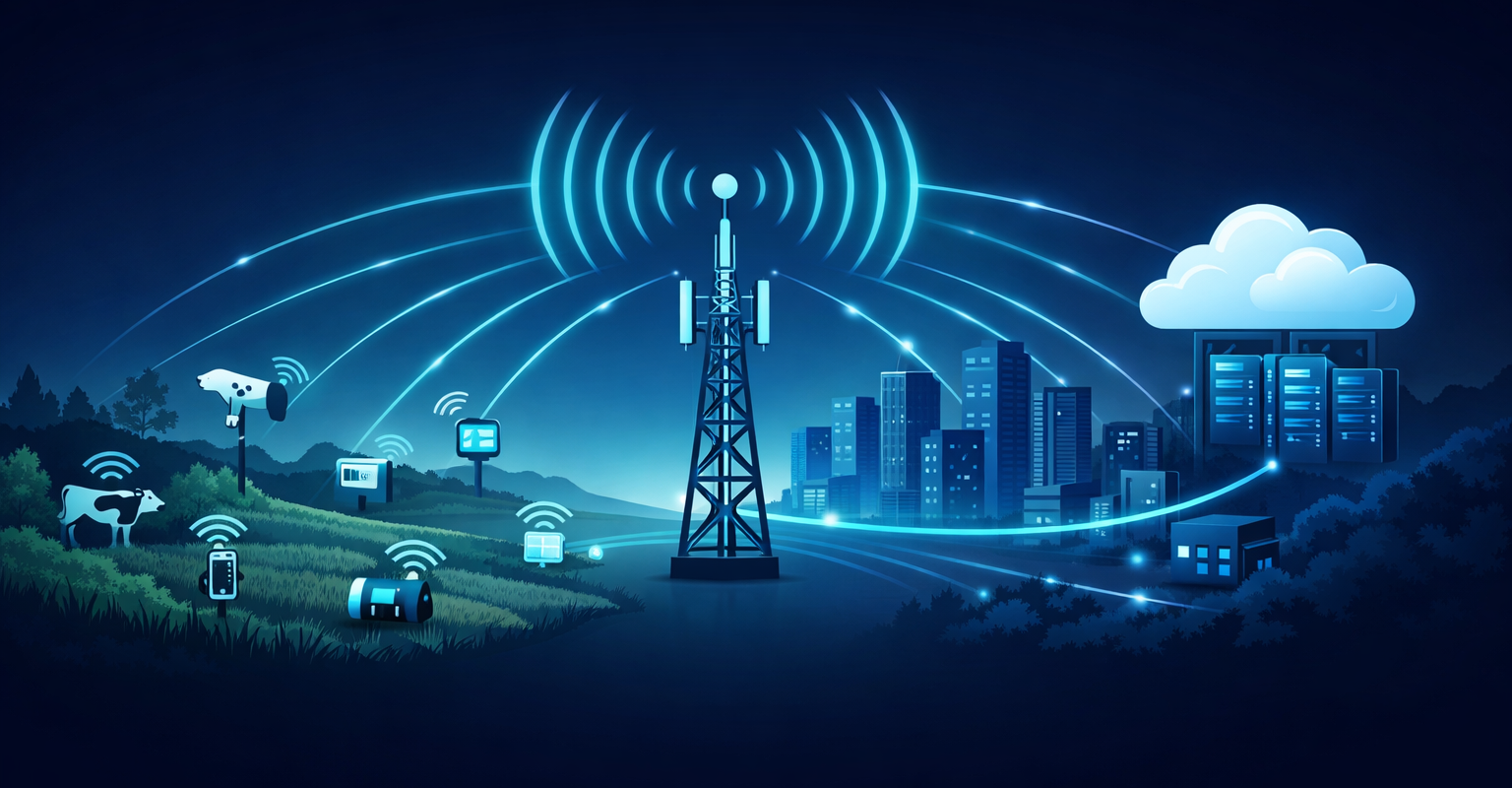
LPWAN stands for Low-Power Wide-Area Network. It is a class of wireless communication technology designed to do something that sounds straightforward but turns out to be surprisingly hard: connect simple, battery-powered devices over long distances, at very low cost, while consuming almost no energy.
The trade-off is data rate. LPWAN technologies are not trying to stream video or shift large files. They are moving small packets of data – sensor readings, status flags, meter values, asset locations – infrequently. A soil moisture sensor reporting every 15 minutes. A gas meter transmitting a daily reading. A GPS tracker pinging its position once an hour. This is the LPWAN design space.
That design decision unlocks something remarkable. A device running on a pair of AA batteries can operate for five to ten years without any human intervention. Gateways can cover tens of kilometres in open terrain. And the unit economics fall to a level where connecting a £3 sensor across an entire city becomes viable.
Traditional cellular (2G, 3G, 4G) was never designed for this. Wi-Fi has short range and requires mains power at the access point. Bluetooth is for personal area networks. LPWAN fills the gap between all of them.
The LPWAN Landscape: Not One Technology
LPWAN is a category, not a single standard. Several competing technologies sit within it, each with different technical approaches, business models, and deployment patterns. Understanding the differences matters if you are specifying a real deployment.
| Technology |
Spectrum |
Range |
Infrastructure |
Status |
| LoRaWAN |
Unlicensed ISM |
2-15 km |
Private or public |
Active |
| NB-IoT |
Licensed cellular |
Urban/suburban |
MNO-managed |
Active |
| LTE-M |
Licensed cellular |
Urban/suburban |
MNO-managed |
Active |
| Sigfox |
Unlicensed ISM |
3-50 km |
Carrier service |
At risk |
| Wi-SUN |
Sub-GHz ISM |
Mesh, variable |
Utility-deployed |
Niche |
LoRa and LoRaWAN
These two terms are often used interchangeably and should not be. They describe different layers of the same system.
LoRa (Long Range) is the physical radio modulation technique. It was developed by a French startup called Cycleo and acquired by Semtech in 2012. Semtech holds the IP and manufactures the chipsets. LoRa uses a spread spectrum technique called Chirp Spread Spectrum (CSS), which is resistant to interference and capable of extracting signals well below the noise floor. That is why it achieves the range it does.
LoRaWAN is the network protocol layer that sits on top of LoRa. It defines how devices join a network, how data is routed, how security is managed, and how network servers communicate with application servers. LoRaWAN is maintained by the LoRa Alliance, an open industry consortium with hundreds of members.
The distinction matters because LoRa can be used in point-to-point links without LoRaWAN. But when people talk about building sensor networks on LoRa, they almost always mean LoRaWAN.
Sigfox
Sigfox is a French company that built a proprietary LPWAN network using Ultra Narrow Band (UNB) radio technology. It operated on a carrier-as-a-service model – you bought connectivity from Sigfox rather than deploying your own infrastructure. The technology is highly efficient in spectrum terms, achieving very long range with tiny messages (12 bytes maximum per uplink).
Sigfox filed for insolvency in 2022 and was acquired by Unabiz. The Sigfox story is the canonical lesson in proprietary carrier risk: if the carrier fails, so does your deployment. It is the reason private LoRaWAN infrastructure ownership matters.
NB-IoT (Narrowband IoT)
NB-IoT is a 3GPP standard – meaning it was developed by the same standards body that defined 4G and 5G. It uses licensed cellular spectrum and is deployed by mobile network operators as an overlay on existing cellular infrastructure. Devices use a SIM, connect to a cell tower, and data travels over the operator’s core network.
NB-IoT trades the open-network flexibility of LoRaWAN for the managed reliability of a cellular network. Coverage, roaming, and QoS are operator responsibilities. In the UK, Vodafone and Three have deployed NB-IoT. Coverage is improving but still patchy outside urban areas.
LTE-M (LTE for Machines)
Also a 3GPP standard, LTE-M sits above NB-IoT in capability. It supports higher data rates (up to 1 Mbps), voice, and – critically – mobility. A device can hand off between cells without losing its connection. This makes LTE-M appropriate for tracking applications where NB-IoT would drop the connection on the move. Battery life of several years is achievable with careful power management.
Wi-SUN
Wi-SUN (Wireless Smart Utility Network) is a mesh networking standard developed for smart grid applications – primarily utilities. It uses IEEE 802.15.4g radio and operates in sub-GHz bands. Wi-SUN’s distinguishing feature is its mesh topology: devices relay traffic through each other, building a self-healing network that extends range without long-range gateways. It is predominantly used by electricity, gas, and water utilities in large-scale smart metering rollouts.
How LoRaWAN Works
LoRaWAN architecture is worth understanding in some depth, because the design choices have direct implications for deployment.
Network Architecture
A LoRaWAN network has four layers. End devices transmit using LoRa radio without knowing which gateway receives them. Gateways are deliberately dumb – they forward everything they hear without filtering. The network server provides the intelligence: deduplication, join handling, ADR, and payload routing. The application server is where decoded sensor data lands – a building management system, an asset tracking dashboard, a utility MDMS.
LoRaWAN Network Architecture
How a sensor reading travels from field device to application platform
End Devices
Sensor / Node
Temperature, humidity, level, position
📦
Asset Tracker
GPS + LoRa, Class A
💧
Utility Meter
Gas, water, electricity
Gateway
📡
8-Channel Gateway
Receives all LoRa packets. Forwards everything upstream
🏗️
Indoor Gateway
PoE powered, building mount
🗼
Outdoor Gateway
Rooftop/mast, LTE backhaul
IP / LTE
UDP/MQTT
Packet Fwd
Network Server
🖥️
Network Server
Deduplication · ADR · Join · MAC · Security
🔐
Join Server
OTAA key management, AppKey derivation
⚙️
Examples
Chirpstack · TTN · Actility · Everynet
Application
📊
Dashboard
Real-time monitoring, alerts and reporting
🏢
BMS / SCADA
Building and industrial automation platforms
🔌
Utility MDMS
Meter data management, billing integration
Spreading Factors and Data Rate
LoRa modulation uses a parameter called Spreading Factor (SF) to trade range against data rate. SF runs from SF7 (fastest, shortest range) to SF12 (slowest, longest range). At SF7, a device might achieve a data rate of around 5.5 kbps over a few kilometres. At SF12, that falls to 250 bps or less, but range extends dramatically – 15 km or more in open terrain.
Because LoRaWAN operates in unlicensed spectrum, duty cycle restrictions apply (typically 1% in Europe). A device transmitting at SF12 occupies the channel for far longer per packet than one at SF7. In dense deployments, managing spreading factor distribution across the device population is important for network capacity.
Spreading Factor Trade-offs — EU868
RANGE (relative, open terrain)
* Urban environments: divide range by ~4. Gateway elevation matters significantly.
TIME ON AIR (20-byte packet)
* Higher SF = longer airtime = more duty cycle consumed per packet.
Adaptive Data Rate (ADR)
The network server monitors signal quality (RSSI and SNR) reported by gateways for each device. Using ADR, it instructs devices to move to faster spreading factors when signal quality is good, and slower ones when it degrades. This optimises battery life and network capacity automatically. ADR works well for static devices. For mobile devices – trackers on vehicles, for example – it needs to be disabled or modified, as signal quality varies continuously.
Device Classes
Class A
Bidirectional – Baseline
Two brief RX windows open only after device transmits. Otherwise radio is off. Best battery life. Downlink latency equals wait for next uplink. Suitable for most sensors.
Class B
Scheduled Receive Windows
Opens extra RX windows on a beacon-synchronised schedule. Network server knows when device is listening. Lower downlink latency. Moderate battery impact. Used for actuators.
Class C
Continuous Reception
Receiver open at all times except when transmitting. Near-zero downlink latency. Highest power draw – typically mains powered. Street lighting, valve control, industrial actuators.
Join Procedures: OTAA and ABP
OTAA (Over The Air Activation) – The device and network server perform a secure join exchange that generates session keys dynamically. This is the recommended approach. It provides per-session security and allows the network server to assign optimal network parameters.
ABP (Activation By Personalisation) – Keys are hardcoded into the device firmware. Simpler to implement but less secure and less flexible. Frame counters can also become an issue if a device is reset without the network server being updated. Not recommended for production deployments.
Security
LoRaWAN uses AES-128 encryption at two layers. The network session key (NwkSKey) encrypts MAC layer communication between device and network server. The application session key (AppSKey) encrypts the application payload end-to-end between device and application server. The network server never sees the decrypted payload – an important property for sensitive applications.
LoRaWAN Frequencies
LoRaWAN operates in unlicensed ISM (Industrial, Scientific, Medical) spectrum. The specific frequencies depend on region, as spectrum allocation varies by country. The frequency plan in use must match the hardware – a device shipped to a UK deployment must have EU868-capable hardware.
EU868
863-870 MHz
Standard European and UK plan. 8 default uplink channels around 868 MHz. ETSI duty cycle 1% applies. Used across UK, EU, Middle East, Africa.
US915
902-928 MHz
North America. 64 uplink channels, typically 8 used in practice. No duty cycle limit but frequency hopping required.
AU915
915-928 MHz
Australia and parts of South America. Based on US915 channel plan with regional variations.
AS923
920-923 MHz
Japan, Taiwan, Malaysia, Singapore, Vietnam. Similar to EU868 but LBT (Listen Before Talk) is mandatory in Japan.
CN470
470-510 MHz
China. Different frequency set due to Chinese spectrum regulation. Not compatible with EU868 hardware.
IN865
865-867 MHz
India. Three defined channels in a narrow band. Narrow band limits channel plan flexibility.
Applications
LPWAN’s combination of long range, low power, and low cost enables a class of applications that were simply not economical before.
⚡
Smart Metering
Electricity, gas, water. Daily readings. Decade battery life. LoRaWAN and NB-IoT both dominant here.
🌾
Smart Agriculture
Soil moisture, livestock trackers, irrigation control. Long range matters where cellular is sparse.
📦
Asset Tracking
Containers, pallets, tools. GPS periodic updates at a fraction of cellular cost.
🏢
Smart Buildings
Occupancy, air quality, energy sub-metering, water leak detection. Penetrates multiple floors from one gateway.
🏭
Industrial Monitoring
Machine condition, tank levels, cold chain logging. Robust in RF-hostile environments.
🏙️
Smart Cities
Parking sensors, bin fill levels, street lighting, flood sensors. Wide coverage from municipal rooftops.
🏥
Healthcare
Patient wander detection, medication compliance, cold storage monitoring, bed occupancy.
🌊
Environmental
River levels, air quality, noise monitoring, soil contamination. Remote sites with no cellular.
Public vs Private Networks
This is one of the most significant architectural decisions in any LoRaWAN deployment.
Public networks – The Things Network, Helium, operator-managed LoRaWAN – provide shared infrastructure. You register your devices, they connect to nearby gateways you do not own, and you pay per-device subscription fees or nothing at all (in the case of TTN’s community network). The trade-off is that coverage is whatever the network provides, SLA is limited, and your data traverses shared infrastructure.
Private networks – your own gateways, your own network server – give full control. You deploy gateways where you need them, run your own network server (Chirpstack is the most widely deployed open-source option), and own the data path end to end. The upfront cost is higher but the per-device ongoing cost is essentially zero. For industrial, utility, or security-sensitive deployments, private network operation is usually the right answer.
A hybrid approach is also viable – private gateways forming the core of a deployment, with public network coverage as a fallback for mobile devices that roam beyond the private footprint. Both network servers can receive packets from the same devices simultaneously.
LoRaWAN vs NB-IoT: Choosing Correctly
The question comes up constantly. The honest answer is that they are not direct competitors – they suit different deployment profiles.
| Criterion |
LoRaWAN |
NB-IoT |
LTE-M |
| Infrastructure ownership |
✓ Private option |
– MNO only |
– MNO only |
| Rural coverage |
✓ Self-deploy |
– Patchy in UK |
– Patchy in UK |
| Indoor penetration |
Good |
✓ Excellent |
Good |
| Mobility / roaming |
– Limited |
– Limited |
✓ Full handoff |
| Ongoing SIM cost |
✓ No SIM |
Per-SIM fee |
Per-SIM fee |
| Guaranteed delivery |
Best effort |
✓ Operator SLA |
✓ Operator SLA |
| Deployment speed |
✓ Deploy today |
Coverage-dependent |
Coverage-dependent |
| Battery life |
✓ 5-10 years |
3-5 years |
2-4 years |
Many deployments use both: LoRaWAN for static sensors in private environments, NB-IoT or LTE-M for mobile or roaming assets.
Frequently Asked Questions
How far does LoRaWAN actually reach?
It depends heavily on environment. In open, flat terrain – fields, open water – 15 km or more from a single gateway is achievable. In urban environments with buildings, 1-3 km is more realistic. Indoors, penetration through floors and concrete reduces this further. Gateway placement matters: a gateway on a rooftop will dramatically outperform one at ground level.
Is LoRaWAN secure enough for commercial deployments?
Yes, when implemented correctly. AES-128 end-to-end encryption, unique per-device keys, and the separation of network and application session keys provide a solid baseline. The risks come from poor key management – hardcoded ABP keys, shared AppKeys – not from the protocol itself.
Can LoRaWAN handle firmware updates over the air?
Yes, via LoRaWAN FUOTA (Firmware Update Over The Air), defined in the LoRa Alliance standard. It is technically possible but slow – updating a device at SF10 with a modest firmware image takes hours. It is used for critical security patches, not continuous feature deployment.
What is the maximum payload size?
It varies by spreading factor and regional parameters. At SF7 in EU868, the maximum payload is 222 bytes. At SF12, it drops to 51 bytes. For most sensor applications this is more than adequate, but it rules out applications that need to transmit images, audio, or large data structures.
Can one gateway support thousands of devices?
A LoRaWAN gateway with 8 channels can theoretically support thousands of devices. In practice, the limiting factor is duty cycle at the device and gateway level, and the frequency of transmissions. A network of 1,000 devices each sending one packet per hour is trivial. The same number sending every 30 seconds would require careful frequency planning and spreading factor management.
What happens if a packet is lost?
Class A LoRaWAN is not a guaranteed delivery protocol. If a packet is not received by any gateway, it is lost. Application designs must account for this – storing readings locally and retransmitting, or using confirmed uplinks which request an ACK from the network server. Confirmed uplinks reduce battery life and increase duty cycle usage, so they are used selectively.
Do I need a SIM for LoRaWAN?
No. LoRaWAN devices have no SIM. Authentication uses cryptographic keys, not cellular identity. This is one of the reasons the per-device cost is so low – there are no ongoing SIM or connectivity fees for privately-operated networks.
Can LoRaWAN devices be tracked in real time?
Not in the way cellular tracking works. Class A devices only receive downlinks immediately after they transmit, and a typical device might transmit a few times per hour. “Real time” in LoRaWAN terms means minutes of latency at best. For genuine real-time tracking, LTE-M is the more appropriate choice.
What is the difference between a LoRa module and a LoRaWAN gateway?
A LoRa module is a single-channel radio transceiver used in end devices. A LoRaWAN gateway uses multiple radio channels (typically 8) to listen across the full frequency plan simultaneously, receive packets from many devices concurrently, and forward them to the network server. A gateway costs several hundred pounds; an end-device LoRa module costs a few pounds.
Is LoRaWAN suitable for voice or video?
No. The data rates are too low by orders of magnitude. LoRaWAN is strictly for small, infrequent data packets. Maximum payload at SF12 is 51 bytes. Voice requires tens of kilobits per second minimum; LoRaWAN tops out at 5.5 kbps at the fastest setting.
Glossary
ABP (Activation By Personalisation) – A LoRaWAN device activation method where network keys are pre-provisioned in device firmware rather than generated during a join procedure. Less secure than OTAA and generally not recommended for production deployments.
ACK (Acknowledgement) – A confirmation message sent by the network server to indicate a packet was received. Used in confirmed uplink mode.
ADR (Adaptive Data Rate) – A LoRaWAN network server function that dynamically adjusts device spreading factor and transmit power based on received signal quality, optimising battery life and network capacity.
AppEUI / JoinEUI – A 64-bit identifier for the application or join server, used during OTAA join procedure. Renamed JoinEUI in LoRaWAN 1.1.
AppKey – The root cryptographic key used in OTAA join procedure to derive session keys. Must be kept secret and unique per device.
AppSKey (Application Session Key) – An AES-128 session key used to encrypt the application payload. Shared between end device and application server; the network server does not have access to it.
AS (Application Server) – The platform that receives and processes decoded application payloads from end devices.
BW (Bandwidth) – The width of the radio channel used by LoRa. Typically 125 kHz in LoRaWAN, though 250 kHz and 500 kHz are used in some channel plans. Wider bandwidth gives higher data rate.
Channel Plan – The set of radio frequencies and parameters defined for a specific region. Examples: EU868, US915, AS923.
Chirp Spread Spectrum (CSS) – The modulation technique used by LoRa. Data is encoded into frequency-swept chirp signals, giving resistance to interference and sub-noise-floor sensitivity.
Class A / B / C – LoRaWAN device classes defining receive window behaviour and downlink latency characteristics. Class A is the baseline; Class C leaves the receiver permanently open.
Confirmed Uplink – An uplink transmission that requests an acknowledgement from the network server, providing delivery confirmation at the cost of increased duty cycle usage.
CR (Coding Rate) – A LoRa parameter that adds forward error correction to transmissions. Higher coding rates improve link reliability at the cost of increased airtime.
DevAddr – A 32-bit device address assigned to an end device during network join, used to identify the device in over-the-air transmissions.
DevEUI – A globally unique 64-bit identifier for a LoRaWAN end device, equivalent in concept to a MAC address. Used during OTAA join.
Downlink – Communication from network to device. In Class A, only possible in the two receive windows immediately following a device uplink.
Duty Cycle – The proportion of time a radio device is permitted to transmit on a given frequency band. In Europe, the ETSI limit is typically 1% on the 868 MHz sub-bands – a device can transmit for a maximum of 36 seconds per hour.
FUOTA (Firmware Update Over The Air) – LoRa Alliance standard for delivering firmware updates to LoRaWAN devices over the network. Technically feasible but slow due to low data rates.
Gateway – A LoRaWAN infrastructure device that receives transmissions from end devices and forwards them to the network server. Typically supports 8 simultaneous channels.
ISM Band – Industrial, Scientific, and Medical spectrum. Unlicensed frequency bands available for low-power radio devices without spectrum licensing. LoRaWAN operates in ISM bands.
Join Procedure – The process by which an OTAA device authenticates with the network and obtains session keys.
LBT (Listen Before Talk) – A radio access protocol requiring a device to check a channel is clear before transmitting. Mandatory in Japan for AS923 LoRaWAN devices.
LoRa – The physical layer radio modulation technology developed by Cycleo and acquired by Semtech. Uses Chirp Spread Spectrum. Semtech holds the IP; chipsets are licensed to module manufacturers.
LoRa Alliance – The industry consortium that maintains the LoRaWAN specification. Open to members; the specification is publicly available.
LoRaWAN – The network protocol and system architecture built on top of LoRa radio. Defines device classes, security model, join procedures, MAC layer, and network server functions.
LPWAN – Low-Power Wide-Area Network. A category of wireless technology characterised by long range, low data rate, and low device power consumption.
LTE-M – 3GPP cellular standard for IoT devices, supporting higher data rates and mobility than NB-IoT. Also known as eMTC (enhanced Machine Type Communications).
MAC Layer – Medium Access Control layer. In LoRaWAN, the MAC layer handles duty cycle enforcement, ADR, channel selection, and device-network server control messaging.
MQTT – Message Queuing Telemetry Transport. A lightweight publish/subscribe messaging protocol commonly used to deliver LoRaWAN application payloads from network server to application server.
Multicast – A LoRaWAN feature allowing a single downlink to be addressed to multiple devices simultaneously, used primarily in FUOTA operations.
NB-IoT (Narrowband IoT) – A 3GPP cellular LPWAN standard operating in licensed spectrum, deployed by mobile network operators. Uses SIM-based authentication and operator-managed connectivity.
NS (Network Server) – The central intelligence of a LoRaWAN network. Handles deduplication, ADR, join procedures, MAC commands, and payload routing.
OTAA (Over The Air Activation) – The recommended LoRaWAN device activation method, where session keys are generated dynamically during a secure join exchange between device and join/network server.
Packet Forwarder – Software running on a LoRaWAN gateway that receives LoRa radio packets and forwards them to the network server via UDP, MQTT, or other protocol.
PoE (Power over Ethernet) – A standard for delivering DC power over Ethernet cabling. Used to power LoRaWAN gateways without a separate power supply, simplifying installation.
RSSI (Received Signal Strength Indicator) – A measure of signal power at the receiver, in dBm. Used alongside SNR to assess link quality.
RX1 / RX2 – The two receive windows a Class A device opens after each uplink transmission. RX1 uses the same channel and data rate as the uplink. RX2 uses a fixed channel and spreading factor (SF12 on EU868 by default).
SF (Spreading Factor) – A LoRa parameter from SF7 to SF12 that trades data rate for range and link budget. Higher SF means longer range, slower data rate, and longer airtime.
Sigfox – A French LPWAN technology using Ultra Narrow Band modulation. Filed for insolvency in 2022; acquired by Unabiz. Serves as a cautionary example of proprietary carrier risk.
SNR (Signal to Noise Ratio) – The ratio of desired signal power to background noise, in dB. LoRa can decode signals at negative SNR values, which is the primary reason it achieves the range it does.
Sub-GHz – Frequencies below 1 GHz. LoRaWAN, Sigfox, NB-IoT, and most LPWAN technologies use sub-GHz spectrum for its superior propagation characteristics – lower path loss and better building penetration than 2.4 GHz or higher.
Time on Air – The duration of a single radio transmission. A function of spreading factor, bandwidth, coding rate, and payload size. Critical for duty cycle compliance.
TTN (The Things Network) – A global community-run LoRaWAN network, providing open-access infrastructure for development and low-volume deployments.
Unconfirmed Uplink – An uplink transmission with no acknowledgement requested. Default for most applications; lowest duty cycle and power consumption.
Uplink – Communication from device to network.
Wi-SUN – A mesh networking standard used primarily in utility smart grid applications. Uses IEEE 802.15.4g radio in sub-GHz bands.