
IoT and Connectivity
Cheugugi: Joseon Korea’s National Rainfall Measurement Network (1441-1907)
There is a particular kind of arrogance that settles into modern thinking about data, a quiet assumption that…
Thinking Out Loud · Nick Appleby
In the winter of 2003 I stayed in a big hotel overlooking Red Square. I remember three things about it with total clarity, and almost nothing else.
The first is that bear was on the menu. Actual bear. I asked for it, mostly to say I had, and the waiter went off to check, came back, and told me apologetically that they did not have any bear in the kitchen. I have thought about that sentence for over twenty years. Not “we are out of bear,” which would suggest bear comes and goes like the soup of the day, but a quiet admission that the bear existed on the page and nowhere else. It was on the menu the way a lot of things are true in Russia: officially, and not in the kitchen.
The second is that the casino in the basement was managed by a man from Romford, which is where I was living at the time. You travel two thousand miles to the centre of a foreign empire, go down into the belly of a hotel by the Kremlin, and the fellow running the roulette grew up ten minutes from your front door. Small world, and getting smaller.
The third thing I remember is that about a week after I left, a bomb went off on the pavement outside a hotel across from Red Square. A woman with an explosive belt, apparently looking for the Duma and stopping to ask directions before it went off in the wrong place. Six people killed. It was the ninth of December 2003. I had been standing on those pavements not long before, complaining about the absence of bear.
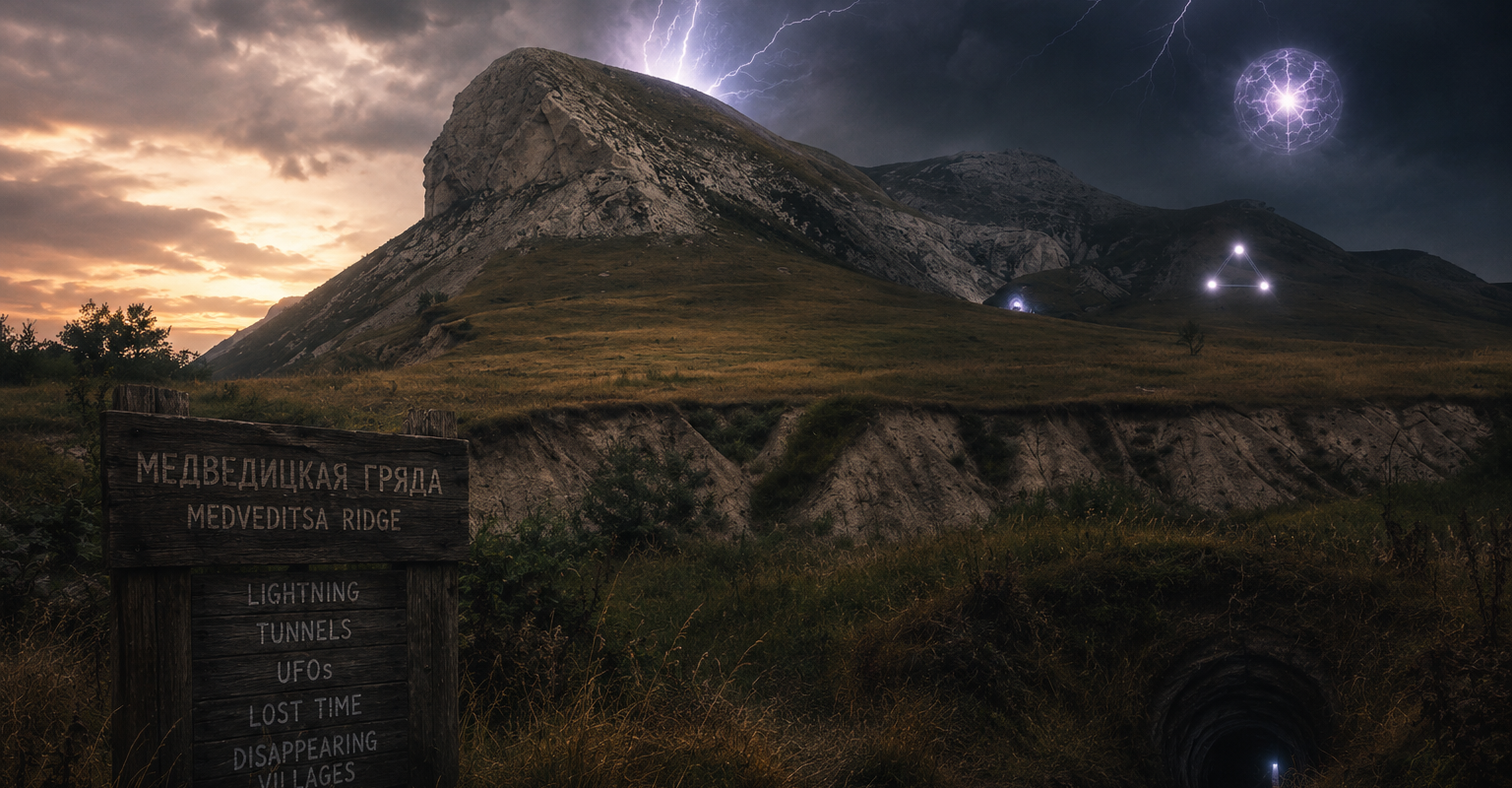
I did not think about any of this again for two decades, until I fell down a hole reading about a hillside in southern Russia. And the first fact I learned about that hillside sent me straight back to the menu. Because the place is called Medveditskaya Ridge, and medveditsa means she-bear.
Medveditskaya Ridge is sold, in the places that sell such things, as one of Russia’s great anomalous zones. The pitch is magnificent. Lightning that travels sideways through trees, splitting them open from the inside. Glowing spheres that drift along fixed invisible routes across a hillside, as if following a road only they can see. Beneath the ground, a network of enormous tunnels, too straight to be natural and too old to be anyone’s, supposedly sealed with explosives during the Battle of Stalingrad. Compasses that wander. Clocks that lose time. A village of white houses that a lost couple stumbled into and could never find again.
It is, in short, exactly the sort of thing I cannot leave alone. Not because I believe it. Not because I want to sneer at it. I am interested in the awkward ground between those two positions, which is where most of the interesting things in life actually live.
And the more I read, the more I realised the mystery was not the one advertised. The genuinely strange thing about Medveditskaya Ridge is not the tunnels or the fireballs. It is watching, almost in slow motion, how an ordinary hillside gets talked into being haunted.
Here is the part the tourist version skips. The ridge is not some arbitrary field a man once decided was cursed. It is a real geological uplift, part of the western edge of the Volga Upland, sitting on top of a broad structural arch. Erosion has cut through it and exposed rocks from several different periods, some of them tens of millions of years old. There is chalk and sandstone and iron-rich sediment. There are springs, ravines, unstable slopes, and a long local history of drilling for oil and gas.
That last detail matters more than any UFO. Because a landscape like that produces strange-looking things all on its own, without any help from the cosmos. It makes stones that come out rounded like discs. It makes cavities and pipes in soft rock that look, in the right light, like the mouths of tunnels. It stains rock the colour of rust and scorch. It bends and kills trees through nothing more exotic than wind, poor soil, fire and the occasional entirely ordinary lightning strike.
So the raw material of the mystery is real. That is what makes it durable. You are never starting from nothing. You are always starting from a real hole, a real distorted tree, a real odd reading on a real instrument, and then the story does the rest.
I have spent most of my working life with this exact problem in miniature, though nobody calls it haunting. A router shows full signal and carries no traffic. A device reports itself offline while the network sits there working perfectly. A customer is certain the mast is down, and three hours later it turns out to be a flat battery, a chewed antenna cable, or someone who unplugged the wrong thing while hoovering. The first explanation is nearly always wrong, because the first explanation is based on what the fault looks like from the outside. Everyone can see the symptom. Almost nobody can see the system underneath it.
Medveditskaya is that problem written very large, across a whole hillside, over forty years, with fireballs.
Read enough of the material and you can watch it get assembled, like sediment, one layer at a time.
At the bottom is the geology. The real rocks, the real erosion, the real weather. Nothing supernatural, just a genuinely varied and difficult bit of country.
On top of that sits the folklore. The disappearing village, the underground people, the pale figures in the woods, the valley where you lose your way. These are lovely, and they are also some of the most widely travelled stories in the world. Vanishing villages and fairy settlements turn up wherever there are marshes, mines, caves and lonely woods, from the Pennines to the Baltic. The honest question is not whether they are true. It is why this landscape produced these stories, and the answer is usually that disorientating terrain has always made people feel watched. What is much harder to find is a single dated, pre-war record proving any of it was told, in the detailed form we now hear, before the modern mystery-hunters arrived.
Above the folklore sits Soviet secrecy, which is possibly the most powerful ingredient of all. Real oil exploration. Real military history. Real drilling and excavation, badly recorded and rarely explained to the public. When there are genuine holes in the ground and genuine holes in the record, rumour flows into both. Every blocked cave becomes “sealed in 1942.” Every survey team that once looked at the subsurface becomes proof that they found something and covered it up. You do not need a conspiracy for this. You just need incomplete paperwork and a public that has learned, with good reason, not to trust the official version.
Then come the investigators, and this is where it gets genuinely interesting rather than merely sceptical.
From the 1980s onward, the ridge became the long-running project of Vadim Chernobrov and the group that became Kosmopoisk. And the easy thing, the cheap thing, would be to make him a fool. I do not think that is fair, and I do not think it is accurate.
Chernobrov comes across as genuinely fascinated and unusually persistent. He went back again and again. He organised expeditions, interviewed residents, made maps, dragged equipment up a remote hillside and tried to turn anecdote into something like observation. In a field almost entirely made of campfire stories, he was at least reaching for a ruler.
But he arrived carrying a framework. UFO routes. Anomalous zones. Ball lightning. Unknown technology. And once you bring the framework, everything you find slots neatly into it. A circular patch in a field becomes a landing site rather than a fairy ring, a fungal ring, or where a farmer parked something. A wandering compass becomes an energy anomaly rather than iron in the rock. A blurry light becomes traffic on the invisible road.
Which leaves the question I keep circling, and cannot quite put down:
Were the expeditions discovering what the ridge is, or slowly teaching it what kind of mystery it was supposed to be?
Because the two are almost impossible to tell apart from the outside. Twenty quiet nights when nothing happens leave no trace at all. One night with a strange light becomes permanent. Do that for forty years and you do not end up with a record of the place. You end up with a highlight reel that has forgotten it is a highlight reel.
If you want the whole story in one object, take the stone discs.
In 2015 an expedition made a great deal of some rounded stone “discs” found near the Medveditsa River. They looked manufactured. They looked, in a photograph, like something. There was iron in them, which was taken as another point in favour of the artificial, the ancient, the not-from-here.
Then a geologist from Saratov, Vyacheslav Krasnov, looked at them and gave the boring answer. They are concretions. Minerals cement themselves around a nucleus in the sediment, erosion later frees them, and you get these surprisingly regular shapes, formed somewhere between forty-five and seventy million years ago by nothing more sinister than chemistry and water.
Here is the thing I want to be clear about. The boring answer does not make the discs less impressive. It makes them impressive about a different thing. “An artefact of a lost civilisation” is, frankly, a smaller and more familiar idea than “the ground has been quietly manufacturing near-perfect stone wheels since before there were people to be baffled by them.” The natural explanation is the bigger one. It usually is.
The clever move, the one that made Medveditskaya feel more solid than it is, was the arrival of numbers.
At some point the story stopped saying “witnesses saw lights” and started saying “the magnetic field increased several times” and “graphs showed regular fluctuations.” Physicists get name-checked. Readings get quoted. And it works, because a number sounds like evidence even when it is only a costume.
A real magnetic reading tells you the instrument, the calibration, the exact spot, the height, the geomagnetic conditions that day, the pipelines and vehicles and buried metal nearby, and whether anyone got the same result twice. Strip all that out and “the field increased several times” is not a measurement. It is a rumour wearing a lab coat. If the Earth’s magnetic field genuinely multiplied on that hillside, it would not be hiding in an anecdote. Every oil company that ever surveyed the region would have tripped over it.
The ridge did not acquire scientific evidence. It acquired the vocabulary of scientific evidence, which is a very different and much cheaper thing.
Yes, in the modest sense that matters least to the brochures and most to me.
The best-supported mystery is narrow and genuinely worth a look. It is possible that the particular combination of a raised, exposed ridge and the local weather really does make that slope unusually good at attracting lightning. Elevated ground shortens the path for a strike. Exposed trees make natural conductors. Decades of ordinary strikes leave a wood full of extraordinary-looking scars. That is a real, testable question, and nobody, as far as I can find, has ever properly answered it with the boring kit it would need: a few storm seasons of proper lightning-location data, some tree-ring forensics, cameras in fixed positions.
Ball lightning may well happen there too, now and then, the way it apparently happens in a lot of stormy places. It is a real and still poorly understood phenomenon. But “occasionally, so might anywhere” is a long way from “organised fireballs patrol fixed underground routes,” and the distance between those two sentences is where the whole industry lives.
The tunnels, the melted walls, the buried civilisation, the broken clocks, the fields that multiply the magnetic force of the planet? Those are stories in search of evidence, not evidence demanding an explanation. Nobody has ever walked and mapped kilometres of that supposed tunnel network. When radar fails to see through the ground, that is not a mysterious shield absorbing the signal. That is wet clay doing exactly what wet clay does to radar.
I said at the start that I do not believe it and do not want to sneer at it, and I have talked myself, over about two thousand words, into an odd sort of affection for the place.
Not for the aliens. For the mechanism. Medveditskaya is the cleanest example I have found of how a real thing becomes a myth. Take a landscape that genuinely produces oddities. Add old stories that feel ancient and mostly are not. Pour in secrecy until the gaps fill with rumour. Send in sincere people carrying the answer they already believe. Let the television and the websites strip out every “possibly” and “reportedly,” because certainty reads better. Repeat one source five times until it sounds like five sources agreeing. Do all that for forty years and you end up with a mystery far more detailed than the evidence underneath it. A menu with bear on it, and nothing in the kitchen.
And the small-world part, the part I only noticed writing this: 2003. The year I was standing on those pavements by Red Square wondering where my bear had got to was the same year Channel One put Medveditskaya Ridge on national television as one of the most mysterious places on Earth. While I was two thousand miles north being told, gently, that the bear did not exist, a hillside named after a bear was being told, on primetime, that it absolutely did.
The tragedy of the ridge is not that science ruined it. It is that the most dramatic claims were repeated for four decades and never got the one thing that would have settled them either way: someone patient, uncommitted and properly equipped, willing to spend the boring seasons when nothing happens. The failure was not too much wonder. It was too little instrumentation.
Which, now I think about it, is the story of half my working life. The signal is there. Everyone can see the symptom. Nobody has looked at the system underneath. And nine times out of ten, when you finally do, it turns out to be the battery.
I could be completely wrong about all of it, and I would quite like to be, because “haunted hillside” is a better story than “wet clay and survivorship bias.” If you have been there, or you know the Kosmopoisk material better than I do, or you just want to argue about whether that hotel served me a real menu or a fictional one, drop me a line. I am always interested in the gap between what a thing looks like and what it turns out to be.
Thinking Out Loud · Nick Appleby
There is a particular kind of arrogance that settles into modern thinking about data, a quiet assumption that…
Thinking Out Loud The AI That Reviewed an Article It Never Read – and Accidentally Made a Better…
Every week, someone contacts me with a version of the same request. “My router is slow. I need…