
Thinking Out Loud
Everything Leaves a Mark
I was driving home the other night, half-listening to the news, and a thought arrived uninvited the way…
Thinking Out Loud · Nick Appleby
The paper price tag is quietly dying, and nobody put it to a vote.
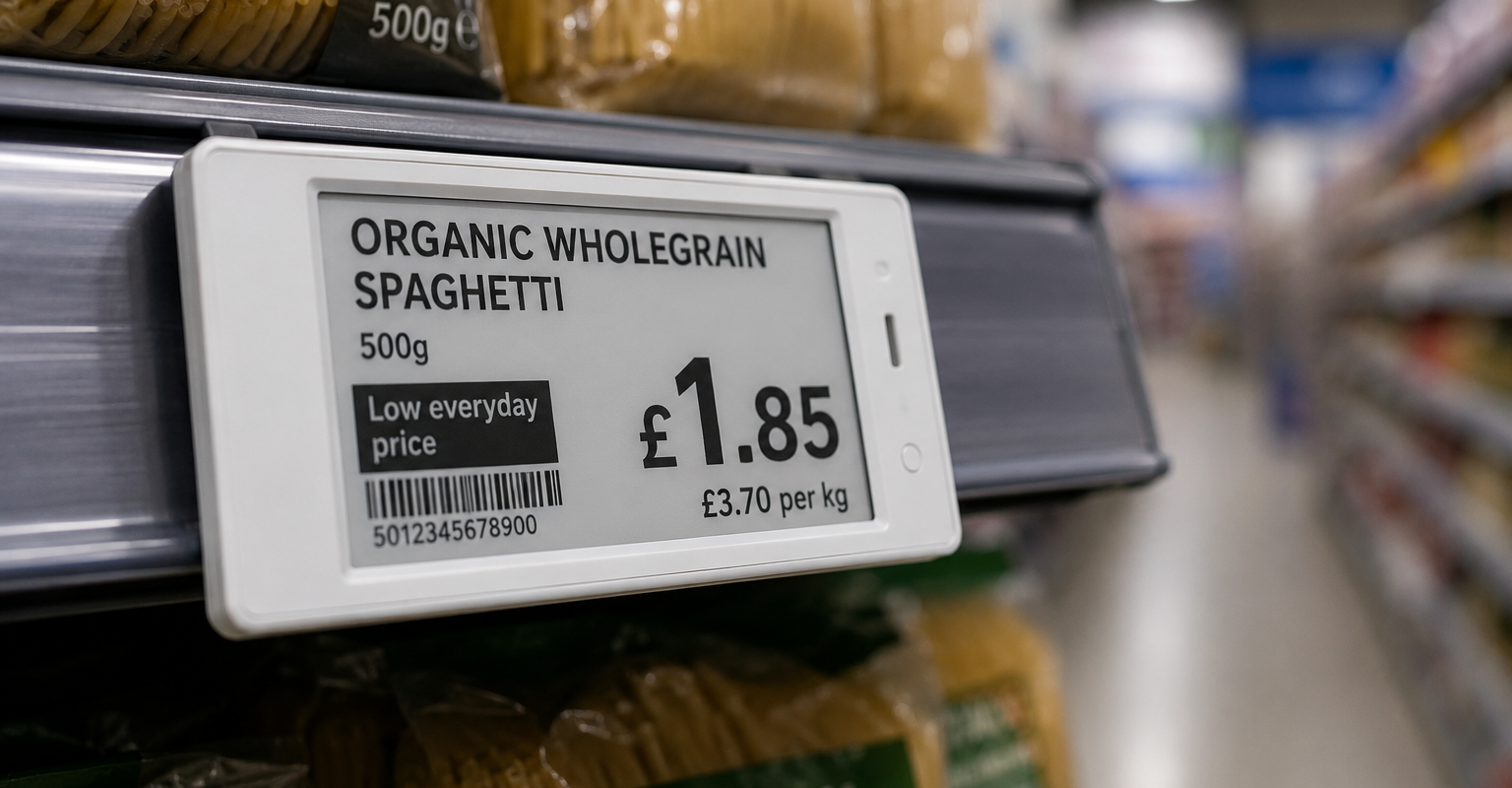
Morrisons is fitting more than 10.8 million electronic shelf labels across all 497 of its supermarkets – the first big UK grocer to go all-in across its entire estate, starting this year. Asda has already put around 700,000 of them into its larger convenience stores. Co-op, Waitrose, Lidl and Aldi are various distances down the same road, with Tesco and Sainsbury’s still in trials. Within a couple of years, the little printed strip on the shelf edge – the one thing in the shop that showed everyone the same number – will be a screen.
I work in connectivity, so my instinct with anything like this is to ask what’s underneath, and what’s underneath is pure IoT. These are e-paper displays sitting on a low-power wireless network, updated from a central server through in-store gateways. Head office changes a price and it lands on millions of shelf edges in seconds. Morrisons is wiring shelf-edge cameras into the same system while it’s at it. That’s the part worth sitting with for a moment. We aren’t really installing better price tags. We’re installing a network that lets the price change instantly, silently, everywhere at once, from a keyboard somewhere you’ll never see.
The supermarkets are adamant this is boring, and they have a point. The British Retail Consortium says its members don’t use, and have no plans to use, dynamic or surge pricing in stores. The pitch for the labels is accuracy, cutting paper waste, freeing up staff, dropping the price on short-dated stock to reduce waste, matching a competitor quickly. Most of that is genuinely true, and to be fair to the retailers, some of the newspaper coverage did leap straight to dystopia off the back of a single Bank of England sentence. Nobody has announced a £2 umbrella that quietly becomes £3 when it starts raining.
But the Bank of England’s actual point was quieter and harder to wave away: the era of the static price is ending, because retailers can now collect and process far more data about us than they used to, and the tag on the shelf can finally move in real time to match. By the Bank’s own reckoning, something like 45% of food and drink businesses already change prices weekly. Electronic labels don’t invent dynamic pricing. They remove the last physical thing that made it slow.
So the honest way to read the rollout isn’t “surge pricing is here.” It’s “the infrastructure for it is going in, wrapped in a reassuring story, and whether it ever gets used that way is being decided right now, mostly without us in the room.”
Here’s why that infrastructure matters so much. The other half of the machine is already built, and we built it ourselves, one Clubcard at a time.
Tesco’s Clubcard has something like 20 million users. Sainsbury’s has Nectar. And “Clubcard prices” and “Nectar prices” have quietly replaced the offers that used to be there for everyone, which means there are now two prices on that yellow label, and which one you get depends on whether you’ve handed over your identity and your shopping history. We’ve completely normalised that. It is already a mild, cheerful form of personalised pricing, and nobody blinks.
It’s not entirely benign, either. A Which? investigation tracked 141 Clubcard and Nectar prices over six months and found that nearly a third of the member-only “promotions” were sitting at their supposedly regular price less than half the time – and referred to the CMA the question of whether “regular” prices are being nudged up to make the loyalty discount look bigger than it is.
Then there’s the watching. Facial recognition is creeping into British shops through firms like Facewatch – Sainsbury’s has trialled it, so have Iceland, Home Bargains, Sports Direct and Southern Co-op – nominally to spot shoplifters, with campaigners at Big Brother Watch warning it “turns shoppers into suspects” and pointing to innocent people wrongly blacklisted. Aim that at theft today, fine. But it’s the same underlying move that pricing needs: identify the specific person standing at the shelf. Loyalty data says who you are and what you’ll buy. Cameras say you’re here. Electronic labels let the shop act on both, instantly, at the shelf edge. Each piece is defensible on its own. It’s the assembled machine that should give you pause.
If you want to see where that machine goes once someone decides to point it at prices, look at the United States, which is roughly a lap ahead of us on this track.
Back in 2019, Target’s app showed a TV at $499.99 from home and $599.99 the moment the shopper pulled into the store car park; across ten items, the basket was $262 cheaper from the back of the lot. Target later paid $5 million to settle a California case and agreed to stop using location to raise prices. More recently, Delta told investors it planned to have AI setting around a fifth of its domestic fares, with its president talking openly about pricing to what people are willing to pay – and three senators warned this amounts to charging each traveller up to their personal “pain point,” before Delta issued a flat denial that it uses personal data to individualise fares. The US regulator’s study of the whole shadowy market reported firms using data as fine-grained as your mouse movements on a page and the contents of a basket you abandoned.
And then the first real law arrived. Since November 2025, any business setting a price for a New York shopper using their personal data has to display the words: “THIS PRICE WAS SET BY AN ALGORITHM USING YOUR PERSONAL DATA.” It’s the first of its kind, it carries a penalty per breach, and it survived a First Amendment challenge from the retail lobby.
None of that is science fiction and none of it is far away. It is Britain’s own data-collection habits, plus the instant-price rails we’re currently bolting to the shelves, with the last bit of friction removed.
And then, a long way past even that, there’s China – which went furthest, fastest, and produced the version that should genuinely worry anyone who runs a loyalty scheme.
The Chinese phrase is 大数据杀熟 – roughly, “using big data to kill the regulars.” And the reason it’s chilling is the inversion. In the West, loyalty is supposed to earn you a discount. In the Chinese scandal, being a known, loyal, high-value customer marked you as someone who wouldn’t bother shopping around – so the algorithm charged you more. Meituan was reported to show iPhone users higher prices than Android users, on the logic that an iPhone signals a customer who’ll pay. In the country’s first price-discrimination lawsuit, in 2021, a Trip.com VIP sued after being charged 2,889 yuan – around £310 – for a hotel room that actually went for 1,377, about £150. Surveys by Beijing consumer bodies found large majorities of shoppers convinced it was being done to them, and state television ran exposés across the big delivery and ride-hailing apps. The platforms denied it, naturally – Meituan blamed a location caching bug – but the belief was near-universal, which tells you something on its own.
Here’s the twist that makes China worth studying rather than just gawping at. Having gone deepest into it, China is now regulating it harder than anyone. Rules from the cyberspace regulator explicitly banned using algorithms for unreasonable differential pricing, and in early 2026 the country’s economic planner, market regulator and internet watchdog moved jointly again to stop platforms charging loyal customers more. So China is running both previews for us at once: the dystopia, and the backlash.
Britain is standing right at the fork. We already run the data-collection half of this machine, cheerfully, because it knocks money off the nappies and the teabags. We’re now installing the instant-price half, under a story about paper waste and staff time that is entirely true and entirely beside the point. Nobody has to flip the switch to surge or personalised pricing for this to matter. The switch just has to exist – and soon it will.
I don’t think the answer is to rip the labels back out or cut up your Clubcard. The data’s long gone, and the technology has honest uses. The answer is the small, unglamorous thing New York reached for: not banning the practice, just refusing to let it happen in silence. The most valuable word in that American price label isn’t “algorithm.” It’s “YOUR.” The price was set using your data. The instant a shop has to admit that out loud, the whole game shifts, because the one thing these systems have always depended on is that you didn’t know they were running.
That’s the bit to carry round the supermarket with you. The tag on the shelf used to be a fact about the product. It’s turning into a guess about you – and for now, in this country, it’s still a guess they have to make quietly. Worth keeping it that way. Or at the very least, worth making them say so.
If you’ve ever caught a price moving on yourself – the same item, a different number, and the only thing that changed was you or where you were standing – I’d like to hear it. Drop me a line.
I was driving home the other night, half-listening to the news, and a thought arrived uninvited the way…

What they are, how they work, where they’re deployed, and why they matter to anyone building connected infrastructure.…

Last week I published Your Magnetic Ink – a piece about a Moody Blues lyric from 1969 that…